
Blog
HGH 191AA Peptide: What It Is, How It Works, and What the Research Actually Shows.

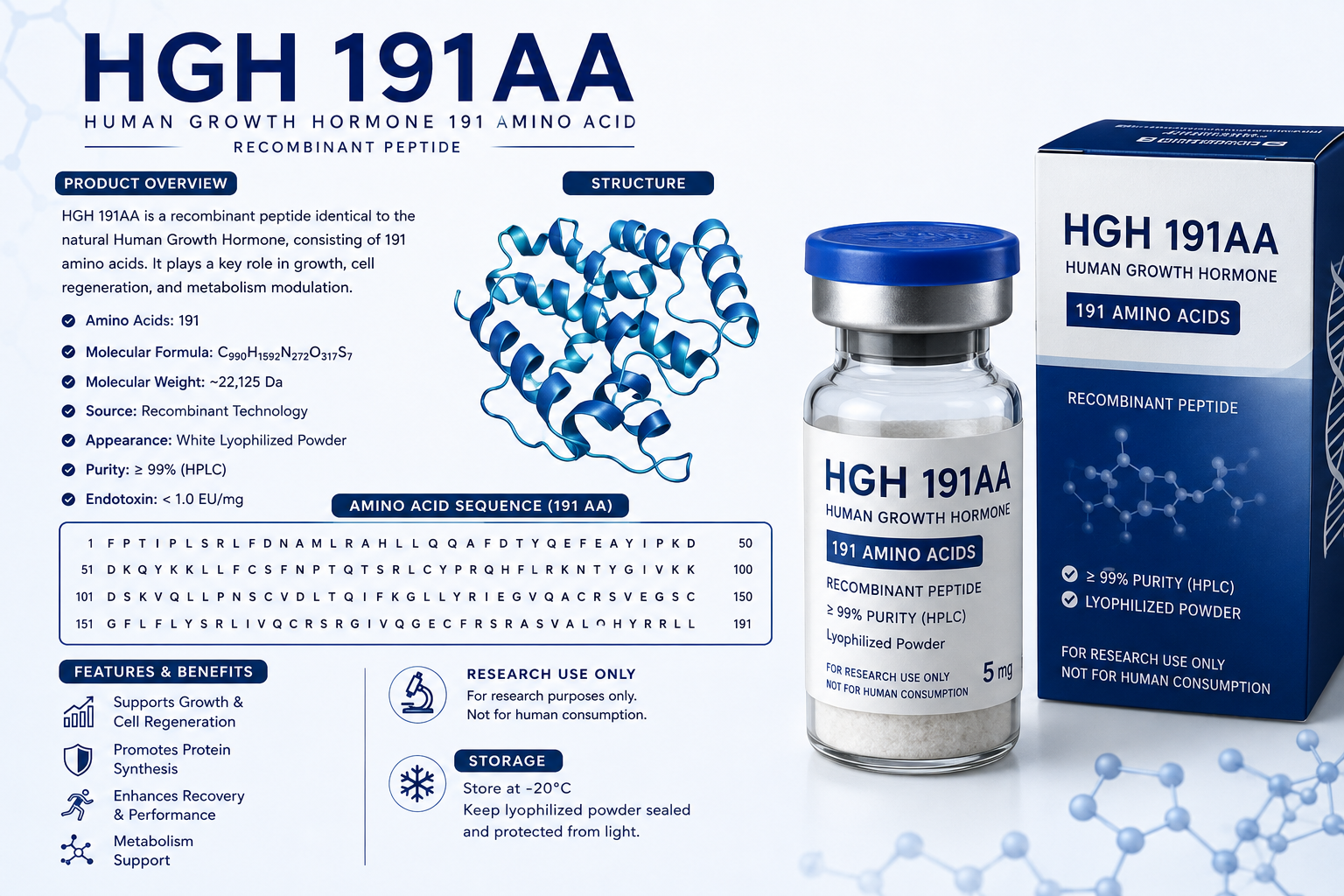
HGH 191AA Peptide is one of the most searched terms in the research peptide and performance biology space — and also one of the most frequently misunderstood. The name sounds like a specialized peptide variant, a particular grade of compound, or a niche research product. It isn’t any of those things.
<cite index=”4-1″>HGH 191AA is not a brand, a grade, or a potency rating — it is a description of the molecule itself. It means the preparation consists of the 191-amino-acid polypeptide chain that makes up the main circulating form of human growth hormone.</cite>
In other words: HGH 191AA is recombinant human growth hormone — the same molecule as pharmaceutical somatropin, the FDA-approved biologic prescribed for growth hormone deficiency and several other specific medical conditions. Understanding what that means — for the science, for the research evidence, for the legal context, and for the real risks — is what this guide is built around.
What Is HGH 191AA Peptide? The Naming Explained
Human Growth Hormone (HGH), also known as somatropin or somatotropin, is a 191 amino acid single-chain polypeptide hormone naturally produced by the anterior pituitary gland. Recombinant HGH (rhGH/somatropin) is bioidentical to endogenous growth hormone and is FDA-approved for growth hormone deficiency in children and adults, as well as several other conditions. The ‘191AA’ designation refers to its complete 191 amino acid structure, distinguishing it from older 192AA formulations.</cite>
The historical context behind the “191AA” designation matters: <cite index=”6-1″>the first recombinant human growth hormone product (Genentech’s Protropin, introduced 1985) used an early bacterial expression system that added an extra methionine residue at the N-terminus, producing a 192-amino-acid molecule. This extra residue had immunological consequences — a small percentage of patients developed antibodies against the non-native sequence. Modern recombinant technology produces the authentic 191-residue sequence identical to pituitary-derived human growth hormone.</cite>
<cite index=”4-1″>The number exists as a label because of this specific historical contrast. The “191AA” designation has survived as a shorthand for “the natural sequence.”</cite>
So when you see HGH 191AA Peptide, 191aa HGH, or HGH-191aa in research peptide contexts, you are looking at recombinant somatropin — the same molecule present in pharmaceutical products like Norditropin, Genotropin, Humatrope, and Omnitrope, manufactured to pharmaceutical standards by major biologic companies under FDA oversight.
The difference is not in the molecule. The difference is in who manufactured it, under what quality standards, and whether it is being used within or outside a legitimate medical framework.
How HGH 191AA Works: Mechanism of Action
<cite index=”1-1″>Somatropin is a 191-amino acid single-chain polypeptide identical to pituitary-derived human growth hormone, binding with equivalent affinity to the growth hormone receptor — a class I cytokine receptor present in liver, muscle, adipose, and most peripheral tissues. GHR binding triggers receptor dimerization and JAK2 activation, initiating three primary downstream cascades: JAK2/STAT5 (primary anabolic signaling pathway driving IGF-1 production in the liver and direct effects in muscle and bone), MAPK/ERK (involved in cell proliferation and differentiation), and PI3K/Akt (metabolic effects including glucose and lipid homeostasis).</cite>
The downstream effects of these cascades explain the breadth of HGH 191AA’s biological activity:
IGF-1 Production: The most clinically significant downstream effect is hepatic IGF-1 (Insulin-like Growth Factor 1) production, triggered by JAK2/STAT5 signaling. IGF-1 mediates most of HGH’s anabolic effects — stimulating protein synthesis in muscle, promoting bone mineral density, supporting organ development, and influencing fat metabolism. Serum IGF-1 is the primary biomarker used clinically to monitor growth hormone status and treatment response.
Direct Lipolytic Effects: HGH 191AA directly stimulates lipolysis in adipose tissue through GHR-mediated signaling, independent of IGF-1. This promotes the release of free fatty acids from fat stores, particularly visceral adipose tissue, for use as metabolic fuel.
Protein Synthesis and Nitrogen Retention: HGH 191AA promotes amino acid uptake into muscle cells and positive nitrogen balance, supporting lean tissue growth and preservation — the basis of its use in GH deficiency and muscle-wasting conditions.
Bone Metabolism: HGH stimulates osteoblast activity (bone formation) both directly and through IGF-1, supporting bone mineral density and longitudinal bone growth — the basis of its use in pediatric growth failure.
Glucose and Insulin Metabolism: HGH has counter-regulatory effects on insulin — it promotes insulin resistance and increases glucose production at higher doses, which is one of its primary dose-limiting side effects. This is why diabetogenic risk is a documented adverse effect of HGH therapy.
<cite index=”9-1″>It works by binding the growth hormone receptor (GHR), activating intracellular signaling (notably JAK2/STAT pathways) and increasing IGF-1 signaling that influences growth and metabolism.</cite>
HGH 191AA Benefits: What the Clinical Research Shows
Because HGH 191AA is pharmaceutical somatropin — an FDA-approved drug with decades of clinical trial data — its benefit profile is significantly better characterized than most research peptides. The evidence base here is clinical trial data, not just preclinical animal research.
FDA-Approved Indications (Established Clinical Evidence)
<cite index=”2-1″>Recombinant HGH (rhGH/somatropin) is bioidentical to endogenous growth hormone and is FDA-approved for growth hormone deficiency in children and adults, as well as several other conditions.</cite>
The current FDA-approved indications for somatropin include:
- Adult Growth Hormone Deficiency (AGHD): Clinically demonstrated improvements in body composition (reduced fat mass, increased lean mass), bone mineral density, lipid profiles, exercise capacity, and quality of life. This is the most evidence-rich adult indication.
- Pediatric Growth Hormone Deficiency: The original indication — documented improvements in linear growth velocity and final adult height.
- Turner Syndrome: Improved height outcomes in girls with Turner syndrome.
- Prader-Willi Syndrome: Improved body composition and growth.
- Short Bowel Syndrome: Improved intestinal absorption in adults.
- HIV-Associated Wasting/Lipodystrophy: Improved lean body mass and reduced visceral fat.
- Idiopathic Short Stature (ISS): Modest improvements in predicted adult height.
- Small for Gestational Age (SGA): Improved catch-up growth.
For all of these indications, the evidence base consists of controlled clinical trials that met FDA standards for safety and efficacy — a level of human evidence that virtually no research peptide can match.
Body Composition Research (Off-Label and Research Context)
Beyond approved indications, the research literature documents HGH 191AA benefits in body composition that have attracted broader research interest:
Fat Loss: <cite index=”1-1″>GH secretion declines approximately 14% per decade after age 30 — a phenomenon termed somatopause. The landmark Rudman 1990 NEJM study demonstrated GH restoration in elderly men reversed multiple markers of aging over 6 months, generating decades of subsequent research examining whether restoring GH to younger levels reverses or merely masks age-associated decline.</cite>
The Rudman 1990 New England Journal of Medicine study remains one of the most cited in anti-aging research — it documented that GH administration in elderly men produced increased lean mass, decreased fat mass, and improved skin thickness. However, it was a small, short-term study (12 subjects, 6 months) without a placebo control for all outcomes, and subsequent larger studies have shown that the gains in body composition are largely reversed upon cessation, and that the side effect burden increases with dose and duration.
Lean Mass Preservation: In GH-deficient adults, somatropin consistently improves lean-to-fat ratio. Whether this benefit extends meaningfully to individuals with normal GH status (the majority of people in bodybuilding and anti-aging contexts) is considerably less well-established — the biological logic of supplementing a hormone that is already at normal levels is different from replacing a deficient one.
Recovery and Tissue Repair: Research in post-surgical and burn injury contexts has documented GH’s role in accelerating tissue repair, protein synthesis, and wound healing — applications that have driven interest in its use in recovery-focused research.
The Anti-Aging Research Landscape
The connection between declining GH/IGF-1 levels and aging — somatopause — has generated substantial research interest in GH supplementation as an anti-aging intervention. The evidence picture is mixed:
On the positive side: multiple studies document that GH restoration in GH-deficient adults improves body composition, bone density, cardiovascular risk markers, and self-reported quality of life in ways that correlate with the measured changes.
On the cautious side: studies in normal-GH populations show smaller, less consistent benefits; side effects increase with dose; and crucially, elevated IGF-1 is associated in epidemiological research with increased cancer risk — a finding that has made the long-term safety of supraphysiological GH supplementation a genuinely open question in the research literature rather than a settled one.
HGH 191AA vs HGH: Understanding the Comparison
The HGH 191AA vs HGH question is frequently asked, and the answer is straightforward: they are the same molecule.
<cite index=”4-1″>Recombinant somatropin, the FDA-approved prescription biologic, has exactly this 191-residue sequence, identical to pituitary-derived human growth hormone.</cite>
The distinction being drawn in practice is usually between:
| Pharmaceutical Somatropin | “Research Grade” HGH 191AA | |
|---|---|---|
| Molecule | Identical 191-aa somatropin | Claims to be identical 191-aa somatropin |
| Manufacturer | FDA-regulated pharmaceutical companies | Unregulated peptide vendors |
| Quality oversight | FDA-mandated GMP manufacturing | No regulatory oversight |
| Purity verification | Required by FDA | Voluntary CoA from vendor |
| Legal status | Prescription drug (Schedule III in US) | Legally ambiguous/controlled |
| Price | Higher | Lower |
| Verified identity | Yes — regulatory batch testing | Variable — independent lab testing recommended |
The biological molecule is the same. The manufacturing quality, purity assurance, and legal context are entirely different. This distinction matters because recombinant growth hormone is a biologic — a large, complex protein molecule that is sensitive to manufacturing conditions, temperature, bacterial contamination, and handling in ways that small-molecule research chemicals are not. Somatropin produced outside pharmaceutical manufacturing standards may be misfolded, degraded, contaminated, or simply not what the label claims.
Independent third-party testing (HPLC for purity and identity, LAL assay for endotoxin, sequence verification) is the minimum quality standard for any HGH 191AA product used in research contexts.
HGH 191AA Side Effects: The Full Safety Picture
<cite index=”5-1″>As with all protein drugs, a small number of patients may develop antibodies to the protein.</cite> Beyond that, the documented HGH 191AA side effects from the pharmaceutical somatropin clinical literature include:
Common (particularly at higher doses or in dose-escalation):
- <cite index=”5-1″>Short-term local injection site reactions, such as pain, numbness, redness, and swelling. The subcutaneous administration of growth hormone at the same injection site over a long period may result in local lipoatrophy.</cite>
- <cite index=”5-1″>Disturbances in fluid balance (edema/swelling), joint pain, muscle pain, stiffness of the hands and feet, numbness.</cite>
- <cite index=”5-1″>Carpal tunnel syndrome in adults</cite> — particularly at the dose escalation phase, often resolving with dose reduction
Metabolic:
- Insulin resistance and impaired glucose tolerance — HGH is counter-regulatory to insulin; at therapeutic doses, this is managed; at higher or unsupervised doses, diabetogenic risk increases
- Elevated IGF-1 — a necessary mechanism for many of HGH’s benefits, but one with long-term implications (see below)
Serious adverse events (documented in pharmaceutical prescribing information):
- <cite index=”5-1″>Benign intracranial hypertension</cite> — increased intracranial pressure; more common in pediatric populations
- Potential oncological risk: Elevated IGF-1 is associated epidemiologically with increased risk of certain cancers. This is the most significant long-term safety concern for unsupervised, prolonged HGH use — not a certainty, but a documented association that the research literature takes seriously.
- <cite index=”5-1″>The safety and effectiveness of HGH in patients age 65 and over has not been evaluated in clinical studies. Elderly patients may be more sensitive to the action of HGH and may be more prone to develop adverse reactions.</cite>
The dose-dependency of side effects is a critical point: the side effect burden of HGH 191AA is substantially dose-dependent. Doses used in GH deficiency replacement (typically 0.2–0.6 mg/day) carry a different risk profile than the higher doses sometimes used in body composition or performance contexts, where side effects are more frequent and more pronounced.
HGH 191AA Dosage: What the Clinical Literature Documents
Given significant search interest in HGH 191AA dosing, it’s essential to present this accurately as clinical reference data — not a protocol.
<cite index=”1-1″>The standard research conversion is 1 mg ≈ 3 IU of recombinant somatropin.</cite>
Pharmaceutical prescribing information for somatropin documents the following dose ranges by indication:
| Indication | Typical Dose Range | Route | Frequency |
|---|---|---|---|
| Adult GH Deficiency | 0.15–0.30 mg/day (starting) | Subcutaneous | Daily |
| Adult GH Deficiency (maintenance) | 0.15–1.33 mg/day (individualized) | Subcutaneous | Daily |
| Pediatric GHD | 0.025–0.035 mg/kg/day | Subcutaneous | Daily |
| HIV wasting | 0.1 mg/kg/day (max 6 mg/day) | Subcutaneous | Daily |
These are the doses with FDA-reviewed clinical data behind them, for specific medical conditions in monitored patients. They are not general-use guidelines for body composition or anti-aging research contexts, where no approved dosing standard exists and where the risk-benefit calculation differs substantially from treating a diagnosed deficiency.
Important context on dose escalation: Pharmaceutical somatropin dosing for adults with GH deficiency is always individualized by starting low and titrating based on serum IGF-1 measurements and symptom response — not by fixed protocols. This clinical monitoring approach is foundational to safe HGH use, and it is not replicated in self-supervised research contexts.
Legal Status: A Critical Consideration
This is where HGH 191AA differs fundamentally from most research peptides discussed in this series — because unlike BPC-157, Semax, or ARA-290, somatropin is a federally controlled substance in the US.
<cite index=”9-1″>It is a prescription therapy for specific medical conditions, and misuse carries meaningful health and legal risks.</cite>
In the United States, human growth hormone is a Schedule III controlled substance under the Anabolic Steroids Control Act. Possession, distribution, and use outside of a valid prescription for an FDA-approved indication is a federal crime — not a regulatory grey area like many research peptides, but a criminal law issue with meaningful penalties.
In the UK, EU, and Australia, somatropin is similarly classified as a prescription-only medicine with controlled substance status in many jurisdictions. The legal risk of obtaining and using HGH 191AA outside a medical prescription framework is substantially greater than with other research peptides.
This legal context is why the “research peptide” framing for HGH 191AA is particularly fraught: unlike genuinely novel research compounds that exist in regulatory grey areas, somatropin has an established legal status in most major markets — as a prescription drug that cannot legally be used outside that framework.
Comparing HGH 191AA to Related Research Approaches
| Compound | Mechanism | Evidence Level | Legal Status (US) | Key Distinction |
|---|---|---|---|---|
| HGH 191AA (Somatropin) | Full GHR agonist → IGF-1, lipolysis, anabolism | Extensive FDA clinical data | Schedule III controlled substance | The real thing — same legal/medical risks |
| Sermorelin | GHRH receptor agonist → stimulates natural GH release | Clinical data; some compounding pharmacy access | Not Schedule III; different regulatory category | Stimulates endogenous GH; less suppressive of natural axis |
| Ipamorelin | Ghrelin receptor agonist (GHSR) → GH secretagogue | Preclinical + early clinical | Unscheduled research compound | Selective GH secretagogue; oral viable |
| CJC-1295 | GHRH analogue → sustained GH release | Preclinical + limited clinical | Unscheduled research compound | Long-acting GHRH; typically combined with ipamorelin |
| HGH Fragment 176-191 | Selective lipolytic fragment of GH | Preclinical only; human evidence lacking | Unscheduled research compound | Targets only fat-burning domain; no IGF-1 elevation |
| MK-677 (Ibutamoren) | Oral GHSR agonist → GH/IGF-1 elevation | Phase 2 clinical data | Unscheduled but FDA-scrutinized | Oral bioavailability; elevates both GH and IGF-1 |
The GH secretagogue pathway (sermorelin, ipamorelin, CJC-1295, MK-677) represents the research direction for stimulating growth hormone effects without administering exogenous somatropin directly — a meaningful pharmacological and legal distinction that drives significant research interest. These compounds work upstream of GH, stimulating the pituitary to produce more of its own GH rather than bypassing the pituitary entirely.
Storage and Handling
For pharmaceutical-grade somatropin and research-grade HGH 191AA, proper storage is critical due to the molecule’s sensitivity:
- Before reconstitution: Refrigerate at 2–8°C; do not freeze. Some formulations may tolerate brief room temperature; check CoA specifications.
- After reconstitution: Refrigerate at 2–8°C; use within 21–28 days (formulation-dependent).
- Protect from light and heat — both degrade the protein.
- Never shake — somatropin is a protein that can denature with mechanical agitation. Roll gently to mix; do not vortex or shake.
- Bacteriostatic water for reconstitution — extends post-reconstitution stability compared to sterile water.
- CoA requirements for research use: Batch-specific HPLC purity (≥98%), sequence verification (to confirm 191-aa structure, not a fragment or contaminant), endotoxin testing (LAL assay), and heavy metal screening are the minimum quality standards for any research application.
Frequently Asked Questions
What is HGH 191AA? HGH 191AA is recombinant human growth hormone (somatropin) — the 191-amino-acid polypeptide identical to the growth hormone naturally produced by the pituitary gland. The “191AA” designation describes the molecule’s amino acid length, distinguishing it from an older 192-amino-acid recombinant formulation that caused more immune reactions. It is the same molecule as FDA-approved somatropin products.
What are the HGH 191AA benefits? The benefit profile of HGH 191AA is the same as pharmaceutical somatropin — the world’s most clinically studied growth hormone. In GH-deficient adults, documented benefits include improved body composition (reduced fat, increased lean mass), improved bone density, better lipid profiles, and improved quality of life. Off-label research has studied effects on recovery, fat loss, and anti-aging markers, with results that are positive but more nuanced than commonly presented.
Is HGH 191AA the same as somatropin? Yes. HGH 191AA and pharmaceutical somatropin are the same molecule — the authentic 191-amino-acid human growth hormone sequence produced by recombinant DNA technology. The difference lies in manufacturing standards, quality assurance, regulatory oversight, and legal status — not in the molecular structure.
Is HGH 191AA legal? In the United States, somatropin is a Schedule III controlled substance. Possessing or using it outside a valid prescription for an FDA-approved indication is a federal offense. Similar prescription-only and controlled substance frameworks apply in the UK, EU, and Australia. This is a materially different legal situation from most research peptides.
What are the main HGH 191AA side effects? Side effects documented in pharmaceutical prescribing data include fluid retention/edema, joint and muscle pain, carpal tunnel syndrome, injection site reactions, insulin resistance, and (with long-term or high-dose use) potential increased risk related to IGF-1 elevation. Side effects are dose-dependent and more common at higher doses.
How does HGH 191AA differ from HGH Fragment 176-191? HGH 191AA is the full 191-amino-acid growth hormone molecule — it activates the full GH receptor and produces the complete range of GH effects, including IGF-1 elevation, anabolic signaling, and lipolysis. HGH Fragment 176-191 is just the C-terminal 16 amino acids (positions 176–191), theoretically targeting only the lipolytic pathway without full GHR activation or IGF-1 elevation. The fragment has no completed human clinical trial evidence, while full somatropin has extensive FDA-reviewed clinical data.
Summary: What HGH 191AA Really Is
The HGH 191AA peptide story is simpler and more consequential than the research peptide marketing around it suggests. It is recombinant human growth hormone — the same molecule as FDA-approved somatropin, with decades of clinical trial data, multiple approved indications, a well-characterized side effect profile, and clear legal status as a controlled substance in most major markets.
The evidence for its benefits in GH-deficient patients is among the strongest in endocrinology. The evidence for benefits in individuals with normal GH levels is more limited, more dose-dependent, and comes with a side effect and long-term safety profile that warrants careful consideration rather than the enthusiasm often found in performance and anti-aging communities.
For anyone researching this area: the molecular science is clear and well-established. The legal and safety context demands the same rigorous attention as the pharmacology. And the appropriate framework for any use of this compound — in any form, under any label — is physician supervision, appropriate diagnostic workup, and the monitoring infrastructure that the clinical evidence was generated within.
For those exploring the evidence landscape around peptides and structural tissue support more broadly, collagenpeptideseu.com provides a well-researched resource on collagen peptides and their role in skin elasticity, joint health, and connective tissue support — a complementary area of peptide research that intersects with the body composition and tissue remodeling interests that often bring researchers to growth hormone science.
Authoritative External References:
- Rudman D et al. (1990). Effects of Human Growth Hormone in Men over 60 Years Old. New England Journal of Medicine. PMID: 2355952
- FDA Prescribing Information — Norditropin (somatropin injection). Available at: fda.gov/drugs
- Molitch ME et al. (2011). Evaluation and Treatment of Adult Growth Hormone Deficiency. Journal of Clinical Endocrinology & Metabolism. PMID: 21602453
- Liu H et al. (2007). Systematic Review: The Safety and Efficacy of Growth Hormone in the Healthy Elderly. Annals of Internal Medicine. PMID: 17261857
- DEA Controlled Substances — Human Growth Hormone Schedule III Classification. dea.gov
This article is for informational and educational purposes only and does not constitute medical advice. Somatropin (HGH 191AA) is a Schedule III controlled substance in the United States and a prescription-only medicine in the UK, EU, and Australia. It is not legal to possess or use outside a valid medical prescription. Always consult a licensed healthcare provider for any growth hormone-related treatment decisions.