
Blog
PEG MGF Dosage: The Ultimate Evidence-Based Guide to Muscle Repair and Recovery

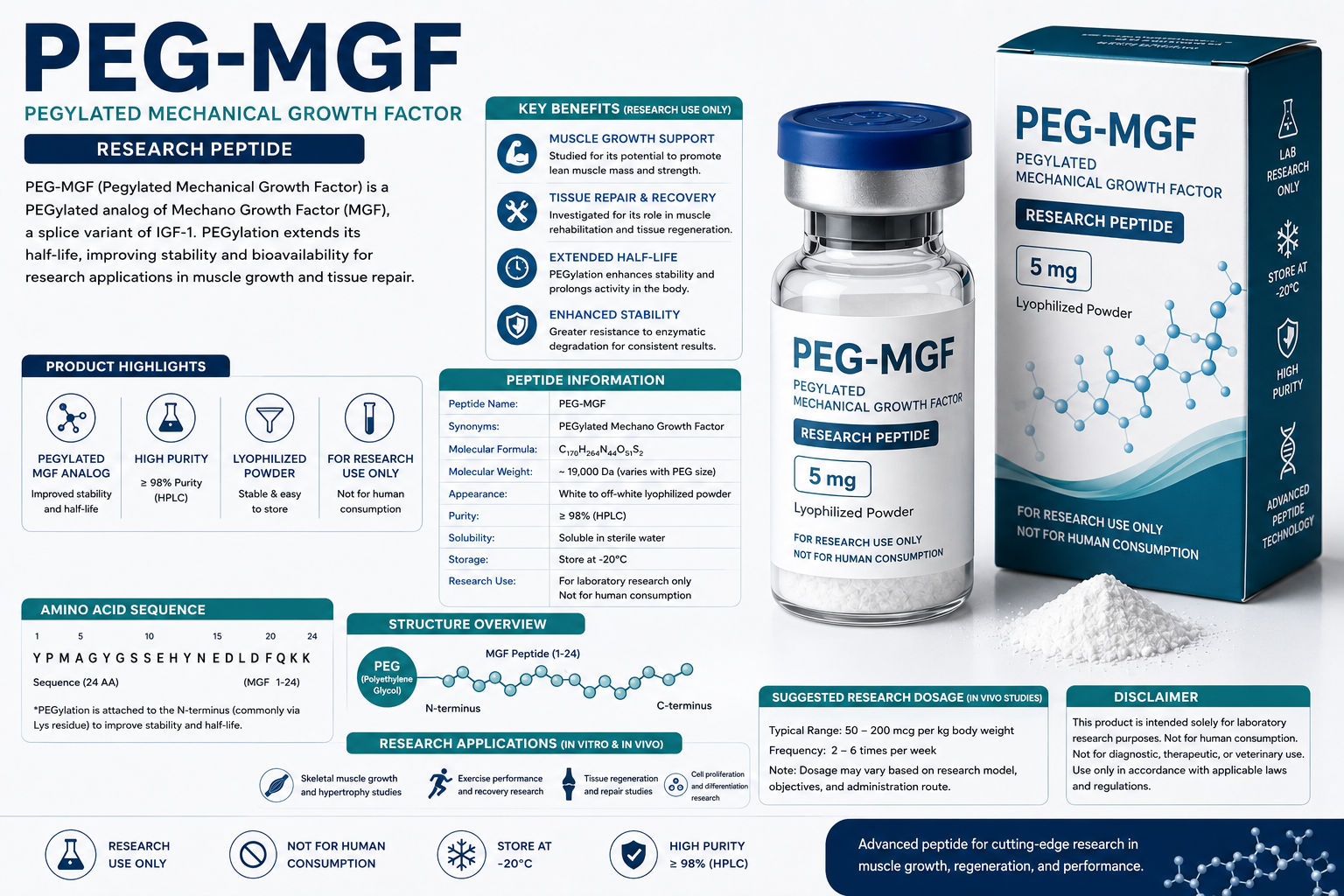
In the rapidly evolving world of performance-enhancing research and regenerative medicine, few compounds have garnered as much attention as Mechano Growth Factor (MGF). Specifically, the pegylated version, known as PEG MGF, has become a cornerstone in studies involving skeletal muscle repair, cardiac protection, and bone healing. For researchers and enthusiasts alike, understanding the correct administration protocol is critical to unlocking its biological potential while maintaining a rigorous safety profile.
This guide provides a comprehensive, evidence-based analysis of PEG MGF. We will explore its unique mechanism of action, the therapeutic benefits observed in clinical research, and the practical protocols often discussed in the context of research applications. By bridging the gap between molecular biology and practical application, this article serves as the definitive resource for anyone looking to understand this powerful IGF-1 splice variant.
What is PEG MGF?
To understand the specifics of a peg mgf dosage, one must first answer a fundamental question: what is peg mgf? Mechano Growth Factor is a splice variant of Insulin-like Growth Factor-1 (IGF-1). It is naturally produced in the body in response to mechanical stress, such as resistance training or tissue injury. Unlike systemic IGF-1, which is primarily produced in the liver, MGF is expressed locally in the muscle tissue to initiate the repair process.
The “PEG” in PEG-MGF stands for pegylation—the process of attaching polyethylene glycol (PEG) molecules to the peptide. This modification is crucial because native MGF has an incredibly short half-life, often breaking down within minutes in the bloodstream. By adding a PEG group, researchers have extended the peptide’s stability and half-life to several days. This allows for a more consistent administration schedule, as the peptide remains active in the system long enough to facilitate sustained muscle cell regeneration.
How PEG-MGF Works: The Science of Satellite Cells
The primary reason researchers study a specific peg mgf dosage is its unique ability to activate muscle satellite cells. Satellite cells are essentially the stem cells of the muscle; they remain dormant until the tissue is damaged. Once activated, they proliferate and fuse with existing muscle fibers, increasing the number of nuclei and enabling hypertrophy (growth) and repair.
The Mechanism of Action
When the peptide is administered, it interacts with the muscle environment through two primary pathways:
1.Proliferation: It triggers the rapid division of satellite cells, creating a larger pool of “building blocks” for muscle repair.
2.Protein Synthesis: It enhances the local environment for protein synthesis, ensuring that the new cells can effectively integrate into the muscle architecture.
Unlike other growth factors that might cause systemic growth, a properly calibrated peg mgf dosage focuses its activity on the localized repair of damaged tissue. This makes it an attractive subject for research into muscle-wasting diseases, age-related sarcopenia, and acute injury recovery.
PEG MGF Peptide Benefits: Beyond Muscle Growth
While many are introduced to this compound through the lens of physical performance, the peg mgf peptide benefits extend into several critical areas of regenerative medicine. The evidence suggests that its role as a repair signal is universal across various tissue types.
1. Enhanced Muscle Hypertrophy and Repair
The most well-documented of these benefits is its ability to accelerate the healing of skeletal muscle. Research in animal models has shown that even a single administration can significantly increase the cross-sectional area of muscle fibers following an injury.
2. Bone and Joint Healing
Emerging studies indicate that MGF plays a role in osteoblast (bone cell) proliferation. A controlled peg mgf dosage may help speed up the recovery of fractures and improve the density of connective tissues, which is vital for long-term joint health.
3. Cardiac Protection
One of the most exciting research applications involves the heart. Following a myocardial infarction (heart attack), the heart tissue often suffers from irreversible scarring. Preliminary research suggests that PEG-MGF may help protect cardiac cells from apoptosis (programmed cell death) and promote the repair of the heart wall.
4. Neuroprotection
Recent data has highlighted the presence of MGF receptors in the brain. This has led to investigations into how a peg mgf dosage might protect neurons from oxidative stress and help in the recovery from traumatic brain injuries or neurodegenerative conditions.
Understanding PEG-MGF Dosage and Research Protocols
Determining the ideal peg mgf dosage requires a careful look at existing research and educational protocols. Because PEG-MGF is not FDA-approved for human use, all dosing information is derived from clinical studies in animal models and anecdotal research observations.
Standard Research Dosing
In most research settings, the peg mgf dosage is administered via subcutaneous injection. The extended half-life provided by pegylation means that daily administration is often unnecessary. Instead, a frequency of two to three times per week is commonly utilized to maintain stable plasma levels.
| Parameter | Common Research Range |
| Weekly Total | 600 mcg – 1,500 mcg |
| Individual Dose | 200 mcg – 500 mcg |
| Frequency | 2–3 times per week |
| Duration | 4 – 8 weeks |
Reconstitution Math: Using a 2mg Vial
Most researchers acquire the peptide in 2mg (2,000 mcg) lyophilized vials. To prepare the solution, the powder must be reconstituted with bacteriostatic water. For example, if you add 2ml of water to a 2mg vial, each 0.1ml (10 units on a standard insulin syringe) will contain a concentration of 100 mcg. A typical research peg mgf dosage of 200 mcg would therefore require 0.2ml of the solution.
PEG MGF Dosage Bodybuilding: Practical Applications
In the fitness community, the discussion surrounding peg-mgf dosage bodybuilding often focuses on the “off-days” or recovery periods. Unlike IGF-1 LR3, which is frequently used pre-workout to drive nutrients into the muscle, PEG-MGF is best utilized when the body is in a state of repair.
Recovery-Focused Cycles
A common protocol involves administering the peptide on rest days or in the evening after a training session. This timing aligns with the body’s natural peak in growth hormone and repair activity. Most anecdotal reports suggest that a peg-mgf dosage bodybuilding cycle of 4 to 6 weeks is sufficient to notice improvements in recovery speed and muscle fullness without significant desensitization.
Stacking with Other Peptides
It is not uncommon to see a peg mgf dosage stacked with other growth-promoting agents. For instance, stacking it with IGF-1 LR3 is a popular research strategy. In this scenario, the IGF-1 provides the initial growth stimulus, while the peg mgf dosage ensures that the satellite cells are replenished and the repair process is sustained.
Safety Considerations and Side Effects
While the peg mgf peptide benefits are impressive, no research chemical is without potential risks. Maintaining a responsible administration protocol is essential to minimizing adverse effects.
Potential Side Effects
•Injection Site Irritation: Redness, itching, or swelling at the site of administration is the most common issue.
•Hypoglycemia: Because MGF is a variant of IGF-1, it can theoretically affect blood sugar levels, though this is less common with a standard peg mgf dosage than with pure IGF-1.
•Water Retention: Some researchers have noted mild edema (swelling) when using a high peg mgf dosage over an extended period.
•Drop in Blood Pressure: A transient drop in blood pressure has been observed in some animal studies following administration.
Safety Precautions
It is vital to emphasize that PEG-MGF is currently classified as a “research chemical.” This means it has not undergone the rigorous human clinical trials required for FDA approval. Anyone considering a peg mgf dosage for research must be aware of the lack of long-term human safety data.
Storage and Handling of PEG-MGF
The stability of your peg mgf dosage depends heavily on how the peptide is stored. Peptides are fragile chains of amino acids that can easily degrade if exposed to heat, light, or vigorous movement.
1.Before Reconstitution: Store the lyophilized powder in a freezer at -20°C for long-term stability. It can be kept in a refrigerator for shorter periods (up to 24 months).
2.After Reconstitution: Once mixed with bacteriostatic water, the peptide must be kept in a refrigerator at 2°C to 8°C. A reconstituted peg mgf dose should ideally be used within 30 days.
3.Handling: Never shake the vial. Gently swirl the water and powder to mix them. Shaking can break the delicate peptide bonds and render your peg mgf dosage ineffective.
Comparison: PEG-MGF vs. IGF-1 LR3 vs. Native MGF
To truly understand the value of a peg mgf dosage, it helps to compare it to its closest relatives in the peptide world.
| Feature | PEG-MGF | IGF-1 LR3 | Native MGF |
| Half-Life | 48–72 Hours | 20–30 Hours | 5–7 Minutes |
| Primary Goal | Satellite Cell Activation | Nutrient Transport/Growth | Acute Repair Signal |
| Dosing Frequency | 2–3 times per week | Daily | Multiple times daily |
| Systemic Effect | Moderate | High | Very Low |
The choice between these compounds depends on the research goal. While IGF-1 LR3 is a potent systemic growth factor, a peg mgf dosage is often preferred for those focusing specifically on the biological “renewal” of muscle tissue through satellite cell proliferation.
Frequently Asked Questions (FAQs)
What is the best time to administer the peptide?
Most research suggests that the best time for administration is during the recovery window—either on rest days or several hours after a workout. This allows the peptide to work alongside the body’s natural repair signals.
Can I use a peg mgf dosage every day?
While possible, a daily peg mgf dosage is usually not necessary due to the long half-life of the pegylated version. Administering it every other day or three times a week is generally considered more efficient for research purposes.
Is PEG-MGF legal?
In most jurisdictions, PEG-MGF is legal to purchase and possess for laboratory research purposes. However, it is not approved for human consumption, and its use in competitive sports is banned by organizations like WADA.
How long does one vial last at a standard peg mgf dosage?
A 2mg vial will last approximately two weeks if you are following a peg mgf dosage of 300 mcg three times per week (900 mcg total per week).
Conclusion: The Future of PEG-MGF Research
The study of peg mgf dosage protocols represents one of the most promising frontiers in muscle biology. By extending the half-life of Mechano Growth Factor, pegylation has transformed a fleeting biological signal into a powerful tool for tissue regeneration. Whether the goal is to combat muscle wasting, accelerate injury recovery, or explore the boundaries of hypertrophy, the evidence-based application of a peg mgf dosage offers a unique pathway to success.
As we continue to unravel the complexities of the IGF-1 system, the role of PEG-MGF will likely expand. For now, researchers must remain diligent, prioritizing high-quality sources and precise administration calculations to ensure that their findings are both safe and scientifically sound. The potential to “reprogram” muscle repair is no longer science fiction—it is a reality being shaped one research study at a time.
Image Suggestions & Alt Text
1.Infographic: MGF Splice Variant Diagram – Alt Text: A scientific diagram showing how IGF-1 splices into MGF and the difference between native MGF and PEG-MGF.
2.Chart: Satellite Cell Activation Cycle – Alt Text: A flow chart illustrating how a peg mgf dosage triggers satellite cell proliferation and muscle fiber repair.
3.Photo: Peptide Reconstitution Equipment – Alt Text: A researcher preparing a peg mgf dose using a 2mg vial, bacteriostatic water, and a sterile syringe.
Authoritative External References
1.Journal of Applied Physiology: Mechano-Growth Factor and Muscle Hypertrophy
2.Growth Hormone & IGF Research: The Role of MGF in Tissue Repair
3.Molecular Therapy: Cardiac Protection and MGF Delivery Systems
4.PubMed: Pegylation of Therapeutic Peptides for Extended Half-Life