
Blog
GHK-Cu Dosage Guide: Benefits, Injection Protocols, and What the Research Shows in 2026.

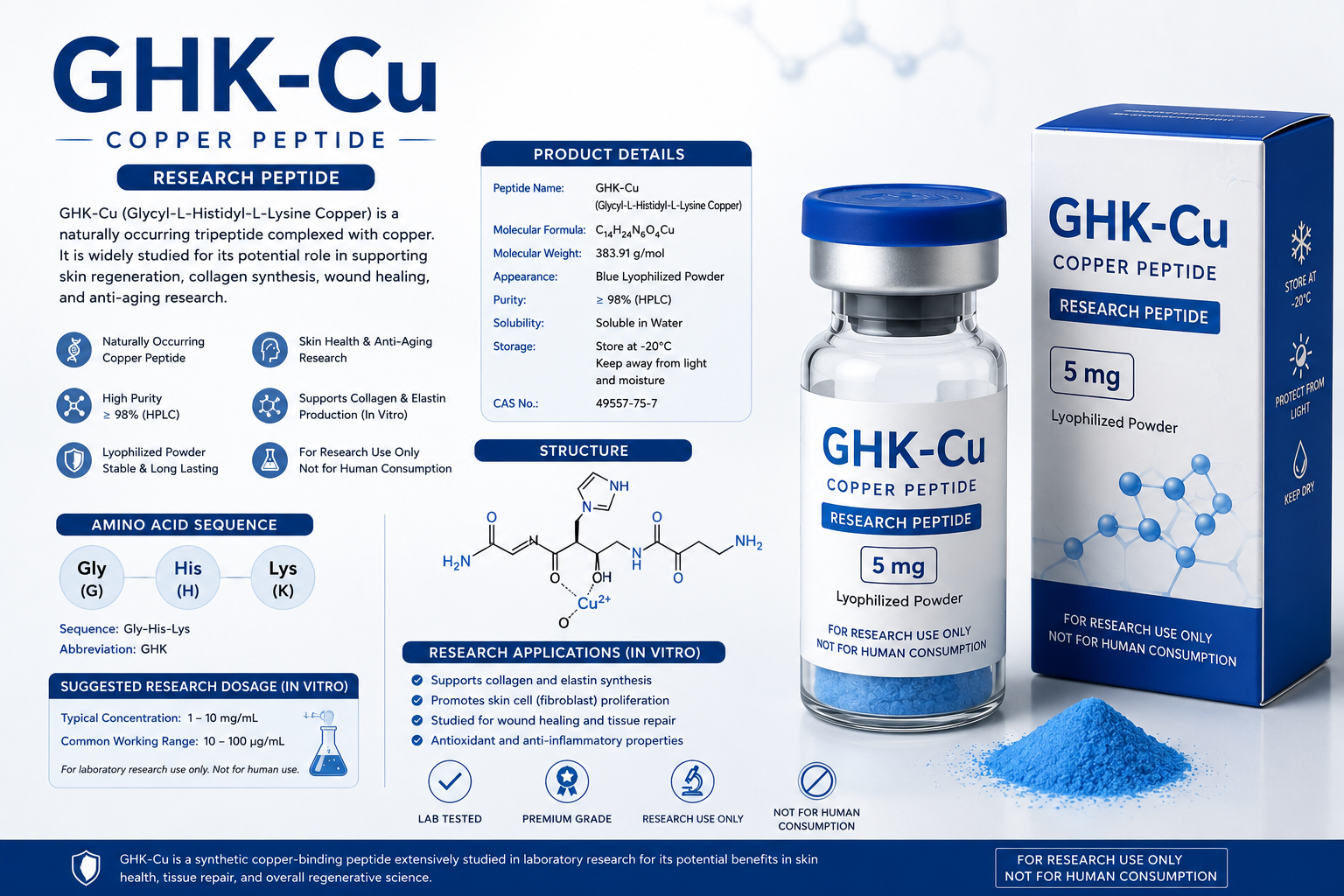
GHK-Cu dosage is one of the most searched terms in the peptide skincare and regenerative research space — and for good reason. GHK-Cu (glycyl-L-histidyl-L-lysine copper) is one of the most extensively researched naturally occurring peptides in human biology, with over four decades of published science, documented effects on thousands of genes, and a well-established role as the foundational component of the GLOW and KLOW regenerative peptide blends. It appears in everything from high-end cosmeceutical serums to supervised injectable protocols.
Understanding the right GHK-Cu dosage for your research context — topical vs injectable, the evidence behind each route, the April 2026 FDA regulatory change affecting injectable compounding, and the genuine GHK-Cu peptide side effects to monitor — is what this comprehensive guide covers.
Important regulatory update (2026): Injectable GHK-Cu was one of the 12 peptides the FDA removed from its Section 503A Category 2 list on April 15, 2026.</cite> This means licensed compounding pharmacies in the US can no longer legally compound GHK-Cu for injectable human use as of that date. Topical GHK-Cu remains widely available in cosmetic and skincare products, where it is approved as a cosmetic ingredient.
What Is GHK-Cu?
GHK-Cu is a naturally occurring tripeptide (glycyl-L-histidyl-L-lysine) carrying a bound copper ion.</cite> It is found naturally in human plasma, saliva, and urine, where it circulates as part of the body’s tissue repair and regeneration signaling system.
Plasma GHK-Cu levels run around 200 ng/mL in young adults and fall to about 80 ng/mL by age 60.</cite> This age-related decline of approximately 60% correlates with reduced fibroblast activity, slower wound closure, thinning skin, weakening hair follicles, and diminished capacity to heal — which is the biological rationale driving research interest in GHK-Cu supplementation.
GHK-Cu is a copper peptide that helps repair and regenerate skin. It’s remarkably active in the body, influencing thousands of genes involved in collagen production, wound healing, and new blood vessel growth. It’s approved as a cosmetic ingredient (often listed as ‘Copper Tripeptide-1’) and has real human studies backing its use for skin rejuvenation, wound healing, and hair growth.
The copper component is not decorative: it is structurally and functionally critical. GHK-Cu’s ability to bind and transport copper ions gives it access to a wide range of copper-dependent enzymes, including lysyl oxidase (critical for collagen cross-linking), cytochrome c oxidase (mitochondrial electron transport), and superoxide dismutase (antioxidant defense). Without the bound copper, GHK loses a significant portion of its biological activity.
How GHK-Cu Works: Multi-Target Mechanism
It shuttles copper to enzymes that protect cells from damage and helps build new collagen by switching on the right growth signals in skin cells. At the same time, it fine-tunes which collagen-clearing enzymes are active, striking a balance between breaking down old tissue and building new tissue, while also calming inflammation.
The mechanism of action spans several interconnected pathways:
Collagen and Extracellular Matrix Remodeling
GHK-Cu’s most thoroughly documented mechanism is its influence on collagen biology. Research has demonstrated that GHK-Cu upregulates type I and type III collagen synthesis in fibroblasts — the primary structural collagens in skin, tendons, and connective tissue. Published studies document a 2.1-fold increase in collagen production in GHK-Cu-treated fibroblast models.
Simultaneously, GHK-Cu modulates matrix metalloproteinases (MMPs) — the enzymes responsible for breaking down old, damaged collagen and extracellular matrix proteins. Rather than uniformly suppressing MMPs (which would prevent healthy remodeling), GHK-Cu fine-tunes MMP activity toward a balanced state that allows removal of damaged matrix while preserving structural integrity. This dual action — more collagen synthesis, better-regulated collagen breakdown — is the foundation of its skin rejuvenation research profile.
Gene Expression Modulation
One of GHK-Cu’s most remarkable research findings is the breadth of its gene regulatory activity. Published transcriptomic research has found that GHK-Cu influences the expression of over 4,000 human genes — approximately one-sixth of the entire human genome. These include genes involved in:
- Anti-inflammatory signaling
- Antioxidant defense (superoxide dismutase, glutathione synthesis)
- Wound repair and growth factor signaling (TGF-β, VEGF, FGF)
- Neurological health and nerve growth factor expression
- Mitochondrial function and energy metabolism
This extraordinary breadth of gene regulatory activity is why GHK-Cu has attracted research interest far beyond dermatology — from lung disease and inflammatory conditions to neurological applications.
Angiogenesis and Vascular Support
GHK-Cu stimulates VEGF (Vascular Endothelial Growth Factor) expression, promoting the formation of new capillaries in damaged or aging tissue. This angiogenic effect is particularly relevant in wound healing, where restored blood supply is critical for tissue repair, and in dermal regeneration, where capillary density correlates with skin vitality and oxygenation.
Anti-inflammatory and Antioxidant Activity
A 2025 Frontiers in Pharmacology study demonstrated that GHK-Cu reduced inflammation in a ulcerative colitis model through the SIRT1/STAT3 pathway. This is an early finding but opens a new category of potential use.
The SIRT1 pathway link is particularly interesting from a longevity research perspective — SIRT1 is one of the major sirtuin deacetylases involved in cellular stress response, mitochondrial biogenesis, and inflammatory regulation. GHK-Cu’s modulation of this pathway suggests mechanisms relevant beyond skin tissue.
GHK-Cu Benefits: What the Research Supports
Skin Rejuvenation and Anti-Aging
This is the strongest area of human evidence for GHK-Cu copper peptides, with multiple published clinical studies:
- Increased skin density and thickness: Published studies using cutometry (skin elasticity measurement) and ultrasound have found measurable increases in skin density and dermal thickness with GHK-Cu treatment
- Reduced fine lines and wrinkles: Multiple small but peer-reviewed human trials have found reductions in wrinkle depth and surface roughness with topical GHK-Cu formulations
- Improved skin elasticity: Measured improvements in skin elasticity (Cutometer R5 and R7 parameters) have been documented in published human studies
- Enhanced skin tone and texture: Clinician-assessed improvements in skin quality, hyperpigmentation reduction, and overall texture have been documented in controlled comparisons
The strongest human evidence is topical and cosmetic.</cite> These studies — the most rigorous in the GHK-Cu evidence base — support the cosmetic ingredient designation and justify GHK-Cu’s position as one of the most evidence-backed active ingredients in the high-end skincare space.
Wound Healing and Tissue Repair
GHK-Cu’s wound healing research has the deepest preclinical evidence base of any application. Cell culture and animal model studies have consistently demonstrated:
- Accelerated wound closure through enhanced fibroblast migration and proliferation
- Improved wound tensile strength through collagen cross-linking support
- Reduced scar formation (anti-fibrotic remodeling)
- Enhanced re-epithelialization and reduced wound infection rates in animal models
Some clinical wound healing data also exists, primarily in the context of post-procedure skin recovery and chronic wound models.
Hair Growth and Follicle Support
GHK-Cu has been studied for androgenic alopecia (pattern hair loss) and general hair follicle health:
- Published studies have found GHK-Cu comparable to 2% minoxidil in stimulating hair growth in some models
- Mechanism: GHK-Cu stimulates dermal papilla cells (the growth-controlling cells at the base of each follicle) and upregulates growth factors including VEGF and KGF that support follicle vascularization and health
- Hair quality improvements (thickness, density) have been reported in controlled studies
Emerging Research Areas
Lung fibroblasts from COPD patients showed healthier gene expression patterns with GHK-Cu exposure in lab research. Animal research suggests anti-anxiety-like and pain-reducing effects. These applications are early-stage but notable.
The COPD-relevant lung fibroblast finding — GHK-Cu appears to partially reverse the pro-fibrotic gene expression patterns found in COPD lung tissue — represents one of the more intriguing early-stage findings in GHK-Cu research beyond dermatology. This is cell culture research, not clinical data, but it is a direction that several research groups are actively exploring.
GHK-Cu Dosage: Topical vs Injectable — Routes and Evidence
GHK-Cu dosage varies significantly by administration route, which reflects both the different evidence bases and the different regulatory landscapes for each format.
Topical GHK-Cu Dosage
Topical GHK-Cu is the best-evidenced route, with human clinical trial data supporting its use in cosmetic skincare:
| Application Type | Typical Concentration | Frequency | Evidence Level |
|---|---|---|---|
| Anti-aging face serum/cream | 0.5–5% w/v | Once or twice daily | Human clinical data (multiple studies) |
| Hair growth serum/topical | 1–3% w/v | Once daily to scalp | Human comparative studies |
| Post-procedure skin recovery | 1–5% w/v | As directed by provider | Clinician/research data |
| Wound care (research) | Variable | Protocol-dependent | Animal + limited clinical |
Most cosmetic products list GHK-Cu as “Copper Tripeptide-1” in the ingredient list, reflecting its INCI (International Nomenclature of Cosmetic Ingredients) designation. Concentrations above 1% are considered active; concentrations below 0.5% provide limited biological activity in most formulations.
Injectable GHK-Cu Dosage — Research Reference (With Critical Regulatory Context)
For the injectable form, reported effects are generally mild, but long-term human safety data is limited. As with any copper-containing product, excess copper exposure is a theoretical concern with high or prolonged use, which is one reason injectable use should be supervised. The injectable form was one of the 12 peptides the FDA removed from its Section 503A Category 2 list on April 15, 2026. Injectable GHK-Cu is not FDA-approved.
This April 2026 FDA change is significant: it means licensed US compounding pharmacies can no longer prepare injectable GHK-Cu for human use. This affects the entire US-based supervised injectable peptide clinic landscape for this compound specifically.
For reference, research protocols prior to this regulatory change documented injectable GHK-Cu dosing as follows:
| Protocol Type | Reference Dose Range | Route | Frequency |
|---|---|---|---|
| General tissue repair (research) | 1–2 mg/day | Subcutaneous | Daily |
| Skin rejuvenation (research) | 0.5–1 mg/day | Subcutaneous | Daily to 3x/week |
| Wound healing (research) | Variable (up to 5 mg) | Local/systemic | Protocol-dependent |
These are historical research reference doses — not current prescribing guidelines. Given the April 2026 FDA regulatory change, injectable GHK-Cu is no longer a legally compoundable option through licensed US pharmacies. The international picture varies by jurisdiction, and any injectable use outside the US should be under physician supervision with awareness of local regulatory requirements.
How Much GHK-Cu Should I Inject Daily?
Injectable and systemic claims rest mostly on cell and animal work, so treat them as research territory rather than settled.
Given the April 2026 FDA regulatory change removing injectable GHK-Cu from the US compounding framework, this question is now primarily relevant for international research contexts or for historical understanding of what protocols were used prior to that change. The research literature reference range was 1–2 mg/day subcutaneously for general tissue repair applications — but with the caveat that this was never an FDA-approved or FDA-reviewed dosing standard, and long-term human safety data at these doses was not established.
For anyone researching GHK-Cu today, the topical route remains the evidence-supported, legally available option in the US and most other markets.
GHK-Cu Peptide Side Effects: Safety Profile
Reported side effects cluster at the application or injection site. The main systemic concern is copper handling, which is why copper metabolism disorders are a hard exclusion.
Topical Side Effects
For cosmetic topical use — the best-characterized route — side effects are mild and uncommon:
- “Copper uglies” / purging reaction: Some users experience a temporary purge-like response in the first 2–4 weeks of use (increased breakouts, temporary skin disruption) before improvement. This appears to reflect accelerated skin turnover rather than an adverse reaction to the compound itself.
- Mild redness or irritation: More common with higher concentrations (>3%) or in sensitive skin types; typically resolves with reduced frequency or concentration
- Temporary skin darkening/bronzing: Some users notice a subtle change in skin tone during initial use; generally transient
Injectable Side Effects
For injectable GHK-Cu (prior to the April 2026 regulatory change), reported adverse events were similarly mild:
- Injection site reactions: Transient redness, mild swelling, and discomfort at the subcutaneous injection site — consistent with other injectable peptides
- Mild nausea: Reported in some accounts, particularly at higher doses
- Copper accumulation risk: Do not use if you have Wilson’s disease, active cancer (theoretical angiogenesis concern), or are pregnant or breastfeeding. Wilson’s disease is a hard contraindication for any supplemental copper peptide — this condition involves dysfunctional copper metabolism, and adding exogenous copper peptides carries real risk of copper toxicity.
The Angiogenesis-Cancer Concern
GHK-Cu’s VEGF-stimulating angiogenic mechanism raises a theoretical concern in oncological contexts: angiogenesis supports tumor growth as well as healthy tissue repair. <cite index=”20-1″>Active cancer (theoretical angiogenesis concern)</cite> is therefore a noted contraindication, particularly for systemic (injectable) use. This is theoretical rather than documented in clinical data — no study has demonstrated GHK-Cu accelerating tumor growth in humans — but it is a precaution that most informed practitioners observe.
<cite index=”19-1″>GHK-Cu has not been evaluated by the FDA for safety or efficacy in humans in the injectable context.</cite>
GHK-Cu in Context: GLOW and KLOW Blends
GHK-Cu at 50 mg forms the foundational and largest component of both the GLOW blend (GHK-Cu + BPC-157 + TB-500) and the KLOW blend (GHK-Cu + BPC-157 + TB-500 + KPV). In both formulations, GHK-Cu contributes the collagen synthesis and tissue architecture signaling while the other components address angiogenesis logistics (TB-500), direct repair signaling (BPC-157), and inflammation modulation (KPV in KLOW).
The 50 mg proportion in these 70–80 mg total blends reflects GHK-Cu’s dose-dependent collagen and gene-regulatory activity — the architectural foundation of the regenerative peptide stack approach.
GHK-Cu vs Related Regenerative Peptides
| Peptide | Primary Mechanism | Main Research Application | Evidence Base | Route |
|---|---|---|---|---|
| GHK-Cu | Collagen synthesis, VEGF, 4,000+ genes | Skin, wound healing, hair growth | Human cosmetic studies + extensive preclinical | Topical (strong); Injectable (research; US compounding removed Apr 2026) |
| BPC-157 | Angiogenesis, tendon repair, nitric oxide | Musculoskeletal, gut healing | Preclinical (extensive); Limited human | Injectable |
| TB-500 (Thymosin β4) | Actin modulation, cell migration | Musculoskeletal, wound healing | Preclinical; Early clinical | Injectable |
| EGF (Epidermal Growth Factor) | EGFR activation, cell proliferation | Skin rejuvenation, wound repair | Human clinical data (topical) | Topical |
| Matrixyl (palmitoyl pentapeptide) | Collagen stimulation (TGF-β pathway) | Anti-aging skincare | Human cosmetic studies | Topical |
GHK-Cu’s position in this comparison is strong: it has the broadest mechanistic reach of any peptide in the table (4,000+ gene targets), the longest research history, and the best-characterized human evidence base for the topical route.
Storage and Handling
For research-grade lyophilized GHK-Cu:
- Before reconstitution: Store at -20°C for long-term stability; -4°C (refrigerator freezer) acceptable for shorter periods
- After reconstitution: Refrigerate at 2–8°C; use within 28 days; avoid light exposure
- Reconstitution: Bacteriostatic water is preferred for injectable preparations (where applicable and legal); sterile water for topical preparations
- Do not shake: Gently swirl or roll to mix; protein degradation risk from agitation
- Quality verification: Batch-specific CoA confirming Copper Tripeptide-1 identity, ≥99% HPLC purity, and copper content verification; endotoxin testing critical for any injectable research application
- Topical formulation stability: GHK-Cu is pH-sensitive; optimal stability in formulations at pH 6.0–7.5; avoid mixing with highly acidic (vitamin C at low pH) or alkaline ingredients that could destabilize the copper-peptide bond
Frequently Asked Questions
What is GHK-Cu dosage for skin rejuvenation? For topical cosmetic use — the best-evidenced route — concentrations of 1–5% in formulations applied once or twice daily have been used in published human studies. For research injectable protocols (prior to the April 2026 FDA change removing injectable GHK-Cu from US compounding), reference doses were 0.5–2 mg subcutaneously daily.
How much GHK-Cu should I inject daily? This question is now primarily relevant for international research contexts following the April 2026 FDA removal of injectable GHK-Cu from the US compounding framework. Research reference data cited 1–2 mg/day subcutaneously for tissue repair applications — but this was never an FDA-reviewed or approved dosing standard, and long-term human safety data was not established.
What are GHK-Cu peptide side effects? Topical side effects are mild: transient purging/skin adjustment reactions, mild irritation at high concentrations, and occasional temporary skin tone changes. Injectable side effects include injection site reactions (redness, swelling, minor discomfort) and theoretical copper accumulation risk with prolonged high-dose use. Wilson’s disease is a hard contraindication. Active cancer is a theoretical contraindication due to VEGF/angiogenic activity.
Is GHK-Cu FDA approved? GHK-Cu is approved as a cosmetic ingredient (listed as Copper Tripeptide-1) for topical use in skincare products. It is not FDA-approved as a pharmaceutical drug for any therapeutic indication. Injectable GHK-Cu was removed from the FDA’s Section 503A Category 2 compounding list in April 2026, meaning US compounding pharmacies can no longer legally prepare it for injection.
What is GHK-Cu injection used for in research? Prior to the April 2026 regulatory change, GHK-Cu injection was researched for systemic tissue repair, wound healing acceleration, skin rejuvenation (systemic collagen support), and as the foundational component of GLOW and KLOW peptide blends. These applications drew on GHK-Cu’s documented collagen-stimulating, angiogenic, and gene-regulatory properties.
Can I use GHK-Cu with retinol or vitamin C? Topical GHK-Cu formulations are generally compatible with most skincare actives, but caution is warranted with highly acidic vitamin C formulations (pH below 3.5) and with retinoids, which may irritate sensitized skin if layered directly. Many practitioners recommend separate application times (morning/evening) when combining GHK-Cu with these actives. From a stability perspective, GHK-Cu is most stable at pH 6–7.5.
How long does GHK-Cu take to show results? <cite index=”20-1″>Visible skin changes typically start around 2–4 weeks, with peak collagen density and firmness improvements at 8–12 weeks. Hair regrowth is slower — 3–6 months minimum.
Summary
GHK-Cu dosage research sits at an interesting intersection: the topical evidence base is the strongest of any naturally occurring peptide in cosmetic science, with decades of research, human clinical studies, and a fully approved cosmetic ingredient status. The injectable evidence base, while scientifically interesting and mechanistically plausible, has been narrowed significantly by the April 2026 FDA removal from the compounding framework — making the topical route the primary, legally accessible option for most researchers and clinicians in the US market going forward.
GHK-Cu is one of the few peptides where even dermatologists and plastic surgeons pay attention to the data — and in 2026, interest has accelerated significantly.
The core takeaway: for skin rejuvenation, wound healing support, and hair growth applications, topical GHK-Cu copper peptides have among the best evidence profiles of any research peptide in those categories. The injectable route’s expanding regulatory constraints in the US mean the field’s focus is shifting back toward topical delivery, where the evidence was always strongest.
GHK-Cu’s role as the collagen-synthesizing foundation of multi-peptide blends like GLOW and KLOW remains unchanged by the regulatory shift — those blends draw on GHK-Cu’s well-documented mechanisms, and the topical science supports GHK-Cu’s position as a cornerstone of peptide-based tissue support research.
For those interested in how collagen peptide research — including the science of hydrolyzed collagen supplementation alongside copper peptide research — intersects to create a comprehensive approach to structural tissue health, collagenpeptideseu.com provides a well-sourced resource on the complementary evidence base for oral collagen peptides and their role in skin, joint, and connective tissue support.
Authoritative External References:
- Pickart L & Margolina A (2018). Regenerative and Protective Actions of the GHK-Cu Peptide in the Light of the New Gene Data. International Journal of Molecular Sciences. PMID: 30200541
- Pickart L et al. (2015). GHK Peptide as a Natural Modulator of Multiple Cellular Pathways in Skin Regeneration. BioMed Research International. PMID: 26180815
- Gorouhi F & Maibach HI (2009). Role of topical peptides in preventing or treating aged skin. International Journal of Cosmetic Science. PMID: 19874100
- Frontiers in Pharmacology (2025). GHK-Cu reduces inflammation in ulcerative colitis model via SIRT1/STAT3 pathway.
- FDA Section 503A Category 2 Peptide List Update, April 15, 2026. fda.gov/drugs/compounding
This article is for informational and educational purposes only and does not constitute medical advice. Injectable GHK-Cu was removed from the FDA Section 503A compounding list in April 2026. Topical GHK-Cu is approved as a cosmetic ingredient. Always consult a licensed healthcare provider before beginning any peptide therapy.