
Blog
Adipotide (FTPP): Research, Clinical Trial History, and the Nephrotoxicity Problem.

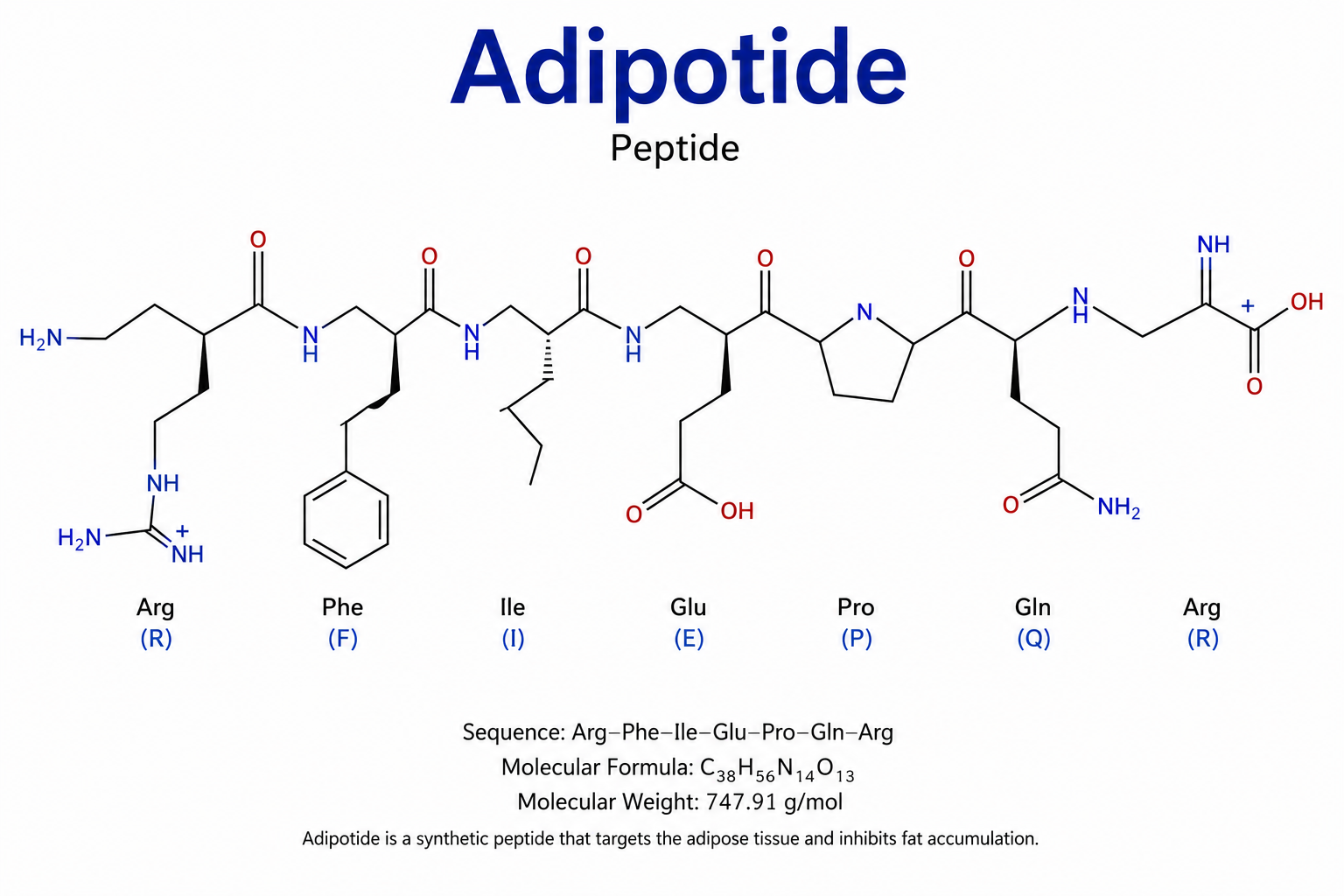
Adipotide is one of the most mechanistically fascinating — and most cautionary — stories in the research peptide space. Developed at a major cancer research institution, it demonstrated some of the most striking fat-loss results ever recorded in primate studies. It entered a Phase 1 human trial. And then clinical development was permanently discontinued, for a reason that the research literature is unambiguous about: the adipotide dosage required to produce meaningful fat loss in primates caused severe, dose-dependent kidney damage that researchers could not separate from the compound’s efficacy.
This article covers the full story: what adipotide is, how it works, what the preclinical and early clinical data actually showed, the specific adipotide side effects that led to discontinuation, the current regulatory status, what the legacy of its research means for next-generation vascular-targeting compounds, and what people researching adipotide dosage need to understand before drawing conclusions from the preclinical literature.
All adipotide dosing data comes exclusively from preclinical animal studies. There are no validated human dosing protocols, and no Phase I or Phase II human clinical trial data has been published.</cite> Clinical development was permanently discontinued in 2019. This article is a research and historical overview — not a clinical protocol.
What Is Adipotide?
<cite index=”25-1″>Adipotide (FTPP, chemical sequence CKGGRAKDC-D(KLAKLAK)2) is a synthetic peptibody-style peptide developed by researchers at MD Anderson Cancer Center. It is designed to selectively bind prohibitin, a protein found on the surface of blood vessels that supply white (fat-storing) adipose tissue. Once bound, its attached pro-apoptotic sequence disrupts mitochondria in those vessel cells, triggering programmed cell death (apoptosis), cutting off blood supply to fat tissue, and causing localized fat cell death.</cite>
Also known by its research designations FTPP (Fat-Targeted Proapoptotic Peptide), Prohibitin-TP01, and TP-1, adipotide was developed through a collaboration between researchers at the University of Texas Health Science Center at Houston — Mikhail G. Kolonin, Renata Pasqualini, and Wadih Arap — and was subsequently licensed to Arrowhead Research Corporation (now Arrowhead Pharmaceuticals) for clinical development.
<cite index=”30-1″>Adipotide represents a first-in-class vascular-disrupting agent specifically engineered to target fat tissue.</cite>
The compound’s architecture is chimeric — it consists of two functional domains fused together:
- CKGGRAKDC — a homing sequence that binds specifically to prohibitin expressed on the endothelial cells (blood vessel lining cells) of white adipose tissue vasculature
- D(KLAKLAK)₂ — a pro-apoptotic effector sequence that, once internalized, disrupts mitochondrial membranes in the target cells, triggering cell death
This “hunter-killer” design is what makes adipotide so scientifically distinct: it navigates directly to fat-supplying blood vessels, delivers a cell-death signal specifically to those vessels, and cuts off blood supply to white fat deposits — causing the adipocytes (fat cells) downstream to die and be cleared by the immune system.
<cite index=”25-1″>Because prohibitin is expressed mainly on white fat vasculature and not brown fat, the mechanism is intended to be tissue-selective rather than a general appetite suppressant or metabolic stimulant.</cite>
How Adipotide Works: The Vascular Targeting Mechanism
Understanding what adipotide is and why it generated such research excitement requires understanding how fundamentally different its mechanism is from every other approach to obesity treatment.
Every other class of weight-management compound works either centrally (in the brain, affecting appetite, reward, or satiety signaling) or metabolically (affecting how the body burns or stores energy). Adipotide does neither.
<cite index=”21-1″>The mechanism behind adipotide is distinct from traditional weight-loss medications. It works by attaching to specific proteins expressed in the vasculature of white adipose tissue. Once internalized, adipotide triggers apoptosis in the endothelial cells supplying fat deposits, leading to reduced blood flow and eventual fat cell death. The body then clears these cells naturally through immune-mediated processes.</cite>
Step by step, the mechanism works as follows:
- Prohibitin targeting: The CKGGRAKDC homing domain binds to prohibitin (PHB) expressed on the endothelial cells lining blood vessels that supply white adipose tissue specifically
- Internalization: The peptide is taken up into the target endothelial cells
- Mitochondrial disruption: The D(KLAKLAK)₂ effector domain reaches the mitochondria and disrupts their membranes, triggering the intrinsic apoptotic pathway
- Vascular collapse: The endothelial cells die → the blood vessels supplying the fat depot collapse
- Fat cell death: Adipocytes are deprived of blood supply → undergo ischemic injury and cell death
- Immune clearance: Dead adipocytes are reabsorbed and cleared by the body’s immune system
<cite index=”20-1″>This targeted approach has sparked interest in adipotide as a potential model for studying selective tissue ablation and vascular targeting.</cite>
The selective expression of prohibitin on white adipose vasculature — but not on brown adipose tissue or other tissues — is what theoretically provides tissue specificity. In practice, the kidney toxicity that emerged in trials suggests the selectivity is not as absolute as the preclinical mechanism implied.
Adipotide Preclinical Research: What the Studies Found
Rodent Studies
<cite index=”28-1″>In diet-induced obese (DIO) murine models, daily administration over approximately 28–30 days produced approximately 30% body-mass reduction relative to controls, with histological confirmation of WAT (white adipose tissue) atrophy, reduced adipocyte size, and improvements in serum leptin, insulin sensitivity indices, and triglyceride concentrations. Lean control animals did not show equivalent WAT changes, consistent with the PHB/ANXA2-selective mechanism.</cite>
A 30% reduction in body mass in 28–30 days — without dietary change — is an extraordinary preclinical result. The fact that lean animals did not show the same effect was particularly significant for the mechanistic claim: the compound appeared to be selectively active in obese metabolic states where prohibitin expression on adipose vasculature is elevated.
Non-Human Primate Studies (Rhesus Monkeys)
The primate studies are the most clinically relevant preclinical data, and they produced both the most exciting efficacy signals and the most alarming safety signals.
<cite index=”27-1″>Preclinical studies demonstrated remarkable efficacy with up to 30% weight reduction in rodent models and 11% weight loss in primate studies over just 28 days.</cite>
<cite index=”22-1″>Initial studies showed that rhesus monkeys receiving adipotide experienced significant weight loss, with reductions in visceral fat and improved metabolic health markers.</cite>
The primate adipotide results included:
- Approximately 11% body weight reduction over 28 days
- Significant reduction in visceral fat
- Improvements in insulin sensitivity
- Improved metabolic health markers broadly
These results — particularly in primates, which are far more physiologically similar to humans than rodents — were what justified advancing to a Phase 1 human trial. They remain some of the most compelling anti-obesity preclinical data produced by any compound in this class.
However, the primate studies also documented what would become the compound’s undoing:
<cite index=”28-1″>Renal safety signals — dose-dependent polyuria and mild dehydration — had been observed in the preceding non-human primate study (Barnhart et al., Sci Transl Med 2011), and these effects escalated to a prohibitive risk-benefit profile at human-relevant doses.</cite>
Adipotide Clinical Trials: The Phase 1 Experience
<cite index=”30-1″>Arrowhead Research Corporation received FDA clearance for a Phase 1 human trial in 2012. A Phase I human trial was initiated in 2012 but was ultimately terminated due to nephrotoxicity, and clinical development was permanently discontinued in 2019.</cite>
<cite index=”21-1″>In early human trials, adipotide showed dose-dependent fat loss but also revealed kidney-related safety concerns that limited further development at higher doses.</cite>
<cite index=”24-1″>A company-sponsored Phase 1 oncology trial was announced in 2012 but produced no peer-reviewed published results. No human efficacy data from the trial have been published as of June 2026, and no subsequent trials have been registered on ClinicalTrials.gov.</cite>
This is an important point for anyone researching adipotide clinical trials: while a Phase 1 trial was conducted, it was terminated early and its data was never published in peer-reviewed form. This means the only published clinical data are the preclinical animal studies — the human trial results exist only in internal company records, if at all.
Adipotide Side Effects: The Nephrotoxicity Problem
This is the most critical section of any honest article on adipotide, because the side effect profile is not a footnote — it is the central scientific reason clinical development stopped.
<cite index=”26-1″>Toxicity Profile: SEVERE — Documented dose-dependent, progressive, often irreversible renal toxicity including glomerular injury, tubular atrophy, proteinuria, and acute kidney failure in non-human primate studies. Therapeutic Index: Approximately 1.0 — doses producing meaningful fat reduction reliably cause kidney damage, rendering compound clinically unviable.</cite>
A therapeutic index of approximately 1.0 is a definitive clinical problem. It means there is essentially no meaningful gap between the dose that produces the desired effect (fat loss) and the dose that causes serious harm (kidney damage). In drug development, a narrow therapeutic index makes a compound extremely difficult to use safely — any individual variation in metabolism, body weight, or kidney function can push a patient from the therapeutic range into toxicity. For an obesity drug intended to be used by millions of otherwise healthy people over months or years, this is effectively an insurmountable obstacle without a fundamental reformulation.
The specific kidney pathology documented includes:
- Glomerular injury — damage to the filtering units of the kidneys
- Tubular atrophy — wasting of the kidney’s reabsorption tubules
- Proteinuria — protein in the urine, a marker of kidney damage
- Acute kidney failure — in the most severe cases in primate studies
<cite index=”31-1″>The dose-response relationship raised concerns about the therapeutic window — the margin between an effective dose and a toxic dose. When that margin is narrow, every dose escalation or individual metabolic variation increases the risk of crossing into nephrotoxic territory. For an obesity drug intended for widespread use, this is essentially a deal-breaker without significant reformulation or targeting improvements.</cite>
<cite index=”29-1″>Individual susceptibility to adipotide kidney toxicity varies widely, making risk assessment challenging.</cite>
<cite index=”24-1″>The kidney is the primary concern because the CKGG homing sequence reaches sufficient concentration in renal tubular cells</cite> — meaning the compound’s biodistribution extends to kidney tissue at therapeutically relevant doses, not just to adipose vasculature as intended.
Additional Side Effects Noted in Preclinical Research
Beyond the dominant nephrotoxicity signal, the primate studies also noted:
- Polyuria (increased urination) — an early renal stress signal
- Mild dehydration — related to polyuria
- Potential off-target vascular effects at higher doses (though these appeared minimal at therapeutic doses in animals)
Adipotide Dosage: Why No Human Protocol Exists
Many people searching for adipotide dosage information are looking for a clinical protocol. The honest answer requires understanding why none exists.
<cite index=”31-1″>All adipotide dosing data comes exclusively from preclinical animal studies. There are no validated human dosing protocols, and no Phase I or Phase II human clinical trial data has been published.</cite>
The doses used in the rhesus monkey studies (the most clinically translatable preclinical data available) produced the documented fat loss results — and the documented kidney damage — simultaneously. Because the therapeutic index is approximately 1.0, these doses are not safely translatable to human use guidelines. The Phase 1 human trial, which might have established a maximum tolerated dose and starting dose in humans, produced no published data before being terminated.
<cite index=”24-1″>There is no legal pathway to obtain pharmaceutical-grade adipotide for human use in the United States, and no provider can legally prescribe it.</cite>
The compound is not on the FDA’s 503A compoundable substances list, meaning licensed compounding pharmacies cannot legally prepare it. It has no approved indication in any jurisdiction worldwide.
For researchers: the published animal model data (Barnhart et al., Sci Transl Med 2011, and the subsequent obesity model studies) contain the dose parameters used in those studies. Any research use of these parameters should be conducted within an appropriate institutional research framework, with full ethical oversight, and with renal function monitoring built into the protocol given the known toxicity profile.
Adipotide vs. Other Fat-Loss Research Compounds: A Comparative View
| Compound | Mechanism | Best Preclinical Fat Loss | Human Trials | Nephrotoxicity | Clinical Status |
|---|---|---|---|---|---|
| Adipotide (FTPP) | Vascular apoptosis targeting prohibitin | ~30% (rodent), ~11% (primate, 28 days) | Phase 1 terminated | Severe, dose-limiting | Development discontinued (2019) |
| Semaglutide | GLP-1 receptor agonism | N/A (approved drug) | Phase 3 completed | None documented | FDA-approved |
| Tirzepatide | GLP-1 + GIP receptor agonism | N/A (approved drug) | Phase 3 completed | None documented | FDA-approved |
| Retatrutide | GLP-1 + GIP + Glucagon triple agonism | Up to 28.7% (68 weeks) | Phase 3 ongoing | None documented | Investigational (Phase 3) |
| HGH Fragment 176-191 | Selective lipolysis via adipocyte signaling | ~30–40% fat cell size reduction (rodent) | None completed | Not documented | Research use only |
| 5-Amino-1MQ | NNMT inhibition → NAD+ preservation | 30–40% fat cell size reduction (rodent) | None | Not documented | Research use only |
The comparison table reveals adipotide’s unique position: the most mechanistically radical fat-targeting approach studied to date, with some of the strongest short-term preclinical fat-loss data in the field — and a safety barrier (irreversible nephrotoxicity at the therapeutic dose) that ended its clinical development entirely.
What Adipotide’s Research Legacy Actually Produced
Despite its clinical discontinuation, adipotide’s scientific contribution is genuinely significant — not as a treatment, but as a proof-of-concept that opened an entirely new research paradigm.
<cite index=”28-1″>Adipotide’s CKGGRAKDC-GG-D(KLAKLAK)₂ architecture serves as the structural reference template from which next-generation prohibitin-targeting compounds — including PTP-r (D-arginine-substituted, JACS 2025, University of Queensland) and prohibitin-binding-peptide nanoparticle constructs — were engineered. Research groups developing improved PHB-targeting peptides with enhanced proteolytic stability, improved mitochondrial localization, or alternative effector mechanisms continue to build on this foundational work.</cite>
<cite index=”27-1″>The foundational research spawned a new class of “hunter-killer” peptides that continue in active preclinical development for both obesity and cancer applications.</cite>
The core insight — that prohibitin is expressed on adipose vasculature and can be targeted for selective tissue disruption — remains scientifically valid. The problem was not the targeting mechanism, but the effector domain (D(KLAKLAK)₂) and its off-target renal reach. Next-generation compounds are attempting to address this through modified targeting sequences, improved tissue specificity, reduced renal accumulation, and alternative pro-apoptotic mechanisms that don’t reach kidney tubular cells at therapeutically relevant doses.
Whether any of these next-generation compounds will successfully separate the fat-loss efficacy from the nephrotoxicity remains the central unsolved problem in this research lineage — and as of 2026, no successor compound has yet published Phase 2 human data.
Current Regulatory Status
<cite index=”30-1″>FDA (United States): IND cleared 2012; Phase I terminated; development discontinued 2019. EMA (European Union): No application filed. Other jurisdictions: No regulatory submissions known.</cite>
<cite index=”24-1″>Products labeled as adipotide or FTPP sold through online vendors exist outside any regulatory framework. There is no FDA oversight of manufacturing, no verified identity of the compound, no guaranteed purity or potency, and no established safe dose for human use. Independent testing of research-peptide products sold online has consistently found contamination, incorrect concentrations, and misidentified compounds. The kidney toxicity signal identified in primate research adds a specific mechanistic reason for concern: obtaining a misdosed or contaminated product that carries D(KLAKLAK)₂ activity is not a trivial risk.</cite>
This is a direct, specific safety concern: adipotide’s active effector domain causes mitochondrial disruption at the cellular level. A contaminated, misdosed, or misidentified product carrying this activity — obtained through an unregulated vendor — poses a genuine risk of serious kidney harm without the monitoring infrastructure that even the terminated Phase 1 trial provided to its participants.
Storage and Handling (Research Context)
For laboratory research use, adipotide as a lyophilized peptide should be:
- Stored at -80°C for long-term stability; -20°C for shorter-term (up to 3–6 months depending on supplier specification)
- Protected from light and repeated freeze-thaw cycles, both of which degrade peptide integrity
- Reconstituted in sterile water or appropriate buffer per the specific research protocol
- Handled with full PPE (gloves, eye protection, lab coat) — this is a compound with a documented severe toxicity profile
- Sourced with batch-specific Certificate of Analysis confirming identity, purity (≥95% HPLC minimum for research use), and endotoxin testing
- Used only within an institutional research framework with appropriate ethical oversight, given the known nephrotoxicity profile
Frequently Asked Questions
What is adipotide? Adipotide (FTPP, Prohibitin-TP01) is a synthetic chimeric peptide developed at the University of Texas Health Science Center to selectively target and destroy the blood vessels supplying white adipose tissue, causing fat cells to die. It was developed by targeting prohibitin, a protein expressed on fat-tissue vasculature, using a two-domain “hunter-killer” architecture.
What are the adipotide peptide benefits shown in research? In preclinical studies, adipotide produced approximately 30% body mass reduction in obese rodents and 11% weight loss in rhesus monkey models over 28 days, along with reductions in visceral fat, improved insulin sensitivity, and improved metabolic markers. These are preclinical findings only — no published human efficacy data exists.
Why was adipotide discontinued? Clinical development was permanently discontinued in 2019 following a Phase 1 human trial that was terminated due to nephrotoxicity (kidney damage). The therapeutic index in primate studies was approximately 1.0 — meaning doses effective for fat loss reliably caused kidney damage, with no safe margin between the two.
What are the adipotide side effects? The primary documented side effects are severe and kidney-specific: dose-dependent renal toxicity including glomerular injury, tubular atrophy, proteinuria, and acute kidney failure in primate studies. Polyuria and dehydration were earlier signals. These effects were the basis for development discontinuation.
Is there a safe adipotide dosage for humans? No. There are no validated, published human dosing protocols for adipotide. All dosing data comes from preclinical animal studies. The Phase 1 human trial produced no published data before termination. No safe human dose has been established.
Are adipotide clinical trials ongoing? No. The Phase 1 trial was terminated and development was permanently discontinued in 2019. No new trials are registered on ClinicalTrials.gov as of mid-2026. Research continues on next-generation prohibitin-targeting compounds, but none have published Phase 2 human data.
Can adipotide be legally prescribed or compounded? No. Adipotide has no approved indication, is not on the FDA 503A compoundable substances list, and has no legal prescribing pathway in the US, UK, EU, or Australia.
What do adipotide results look like in research models? In obese animal models, adipotide results include significant fat mass reduction (up to 30% in rodents, 11% in primates over 28 days), visceral fat reduction, and metabolic improvement — alongside the dose-limiting kidney toxicity that prevented these results from translating to an approved human therapy.
Summary: The Honest Adipotide Assessment
Adipotide represents one of the most scientifically innovative approaches to obesity treatment ever developed — a genuine first-in-class compound that proved the concept of vascular targeting for selective fat elimination. The preclinical adipotide results were remarkable, particularly in primate models. The mechanism is elegant and novel. The foundational research it generated continues to influence active drug development programs.
It also represents one of the clearest cautionary examples in the research peptide space: a compound with extraordinary preclinical promise that could not safely bridge the gap to human use, not because of inadequate research, but because of a fundamental pharmacological problem — a therapeutic index so narrow that fat loss and kidney failure were inseparable at clinically relevant doses.
<cite index=”26-1″>Adipotide represents a first-in-class vascular-targeted peptidomimetic for obesity treatment but was permanently discontinued from clinical development due to unacceptable nephrotoxicity that could not be separated from therapeutic efficacy.</cite>
For researchers studying vascular-targeting mechanisms, adipose tissue biology, or “hunter-killer” peptidomimetic design, adipotide’s published research remains highly relevant foundational literature. For anyone else, the honest summary is: a discontinued compound with no approved use, no safe human dosing standard, and a documented serious kidney toxicity profile — whose legacy matters most as the structural template for the next generation of compounds that may eventually solve the nephrotoxicity problem it couldn’t.
Authoritative External References:
- Barnhart KF, et al. (2011). A peptidomimetic targeting white fat causes weight loss and improved insulin resistance in obese monkeys. Science Translational Medicine. PMID: 21937757
- Kim DH, et al. (2010). Selective targeting of tumor vasculature: exploitation of endothelial cell-surface prohibitin as a therapeutic target. Targeted Oncology
- Kolonin MG, et al. (2004). Reversal of obesity by targeted ablation of adipose tissue. Nature Medicine. PMID: 15448696
- ClinicalTrials.gov — Adipotide/FTPP trial registry (NCT01485042)
- Pasqualini R & Arap W (2016). Vascular targeting and beyond: phage display in vascular biology. Trends in Molecular Medicine
This article is for informational and educational purposes only and does not constitute medical advice. Adipotide (FTPP) has no FDA approval, no legal prescribing pathway, and no established safe human dose. Clinical development was permanently discontinued in 2019 due to severe nephrotoxicity. Always consult a licensed healthcare provider before making any decisions regarding experimental compounds or obesity treatment.