
Blog
Cagrilintide Peptide: Mechanism, Phase 3 Results, and What the Research Shows in 2026

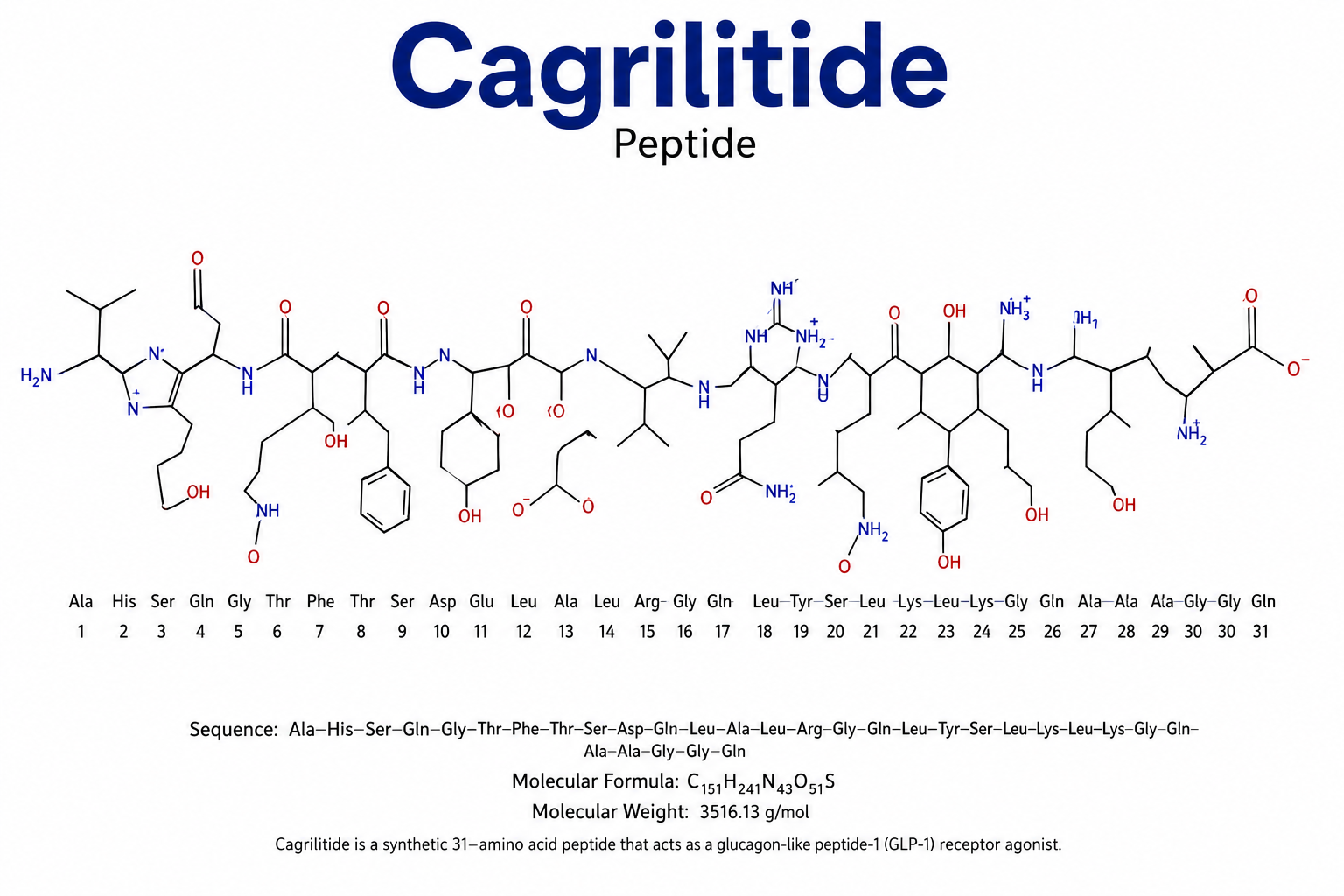
Among the most significant developments in obesity medicine in 2025–2026, cagrilintide stands out as the compound that finally gave the amylin pathway its moment in the clinical spotlight. Combined with semaglutide in the formulation known as CagriSema, the cagrilintide peptide produced Phase 3 weight-loss results that rank among the highest ever reported for a pharmacological intervention — prompting Novo Nordisk to file a New Drug Application with the FDA in December 2025.
This comprehensive guide covers what the cagrilintide peptide is, how its amylin-mimicking mechanism works, what the REDEFINE Phase 3 trials actually showed, the documented cagrilintide side effects, how it compares to retatrutide and other leading obesity compounds, the current regulatory status, and what the research on combination protocols means for the broader obesity treatment landscape.
Regulatory status upfront: As of mid-2026, cagrilintide as a monotherapy and CagriSema as a combination are not FDA-approved. Novo Nordisk submitted the NDA in December 2025; the FDA is expected to review the application through 2026. Neither formulation is currently available outside authorized clinical trials in the US, UK, EU, or Australia.
What Is Cagrilintide?
The cagrilintide peptide is a long-acting synthetic analogue of amylin — a hormone co-secreted by the pancreatic beta cells alongside insulin in response to meals. Developed by Novo Nordisk under the research code AM833, cagrilintide is engineered to mimic and extend amylin’s natural satiety and metabolic signaling effects with a once-weekly subcutaneous injection profile.
<cite index=”93-1″>Cagrilintide mimics amylin, a hormone co-secreted with insulin from pancreatic beta cells. It activates amylin and calcitonin receptors in the area postrema and nucleus tractus solitarius of the brainstem, enhancing satiety signaling.</cite>
Amylin’s role in metabolic regulation has been understood for decades — it’s why pramlintide (Symlin), a shorter-acting amylin analogue, has been FDA-approved since 2005 for use alongside insulin in type 1 and type 2 diabetes. What makes cagrilintide different from pramlintide is its dramatically extended half-life (engineered for once-weekly dosing versus pramlintide’s three-times-daily injection requirement) and its development specifically for the obesity indication alongside GLP-1 co-therapy.
How Cagrilintide Works: The Amylin Mechanism
Understanding why the cagrilintide peptide represents a meaningful advance requires understanding what amylin does — and why targeting it alongside GLP-1 produces better outcomes than GLP-1 alone.
Amylin’s Role in Satiety and Metabolism
In healthy individuals, amylin is released from the pancreas simultaneously with insulin when food is eaten. It performs several complementary functions:
- Slows gastric emptying — reducing the rate at which food moves from the stomach to the small intestine, extending the sensation of fullness
- Suppresses post-meal glucagon — reducing inappropriate glucagon release that would otherwise raise blood sugar after eating
- Signals satiety in the brainstem — acting on the area postrema and nucleus tractus solitarius to tell the brain that a meal has occurred and reduce further food-seeking behavior
- Flattens post-meal glucose spikes — by coordinating the timing of nutrient absorption with insulin response
In obesity, amylin signaling becomes blunted — a phenomenon known as amylin resistance — contributing to impaired satiety feedback and dysregulated glucose control. Cagrilintide is designed to restore and amplify this signaling pathway through pharmacological means.
Why GLP-1 + Amylin Is More Powerful Than GLP-1 Alone
<cite index=”96-1″>The two peptides in CagriSema work on different receptors, and that is exactly why the combination pushes weight loss further than either drug alone. Semaglutide activates GLP-1 receptors, which slows gastric emptying, reduces liver glucose output, and signals the brain’s appetite centers to feel full sooner. Cagrilintide mimics amylin, which also slows how fast the stomach empties, boosts satiety after a meal, and helps flatten post-meal blood sugar spikes. Stacked together, they hit hunger, portion size, and glucose control from two directions at once.</cite>
This dual-pathway mechanism is the same logic behind tirzepatide’s GLP-1 + GIP design — complementary receptors, complementary satiety signals, additive effect on weight loss. The CagriSema combination demonstrated true synergy in clinical trials: the combination achieved significantly greater weight loss than either component administered alone, confirming that the two pathways are genuinely additive rather than redundant.
Cagrilintide Phase 3 Clinical Trials: The REDEFINE Program
The Phase 3 evidence base for the cagrilintide peptide comes primarily from the REDEFINE program — Novo Nordisk’s large, international Phase 3 trial series. The pivotal results were published in the New England Journal of Medicine in June 2025 and presented at the 85th Scientific Sessions of the American Diabetes Association.
REDEFINE 1: Obesity Without Type 2 Diabetes
The landmark trial enrolled 3,417 adults with a BMI of 30 or higher, or 27 or higher with at least one weight-related comorbidity (but without type 2 diabetes). Participants received once-weekly subcutaneous CagriSema (cagrilintide 2.4 mg + semaglutide 2.4 mg) or placebo for 68 weeks.
Key results:
- Mean body weight reduction: -20.4% (treatment policy estimand — all randomized participants, including those who discontinued)
- Mean body weight reduction: -22.7% (trial product estimand — participants who stayed on treatment, no other weight-loss therapies)
- <cite index=”98-1″>60% of participants achieved ≥20% weight loss, and 23% achieved ≥30% weight loss</cite>
- Placebo arm: -3.0% body weight reduction
- Absolute difference: 17.3 percentage points (95% CI: -18.1 to -16.6; P < 0.001)
For context: <cite index=”96-1″>semaglutide alone produced 14.9% weight loss, cagrilintide alone produced 11.5%, and placebo delivered just 3%.</cite> CagriSema’s 22.7% exceeds both components by a significant margin — confirming the synergistic rather than merely additive effect of the combination.
One important nuance: <cite index=”96-1″>Novo Nordisk had internally aimed for a 25% weight-loss target, and REDEFINE 1 fell slightly short. One likely reason: only about half of participants reached the highest dose in the trial.</cite> This suggests the efficacy ceiling for the combination may not yet have been fully characterized at the doses studied.
REDEFINE 2: Obesity With Type 2 Diabetes
The second pivotal trial enrolled 1,200 adults with type 2 diabetes and obesity or overweight over 68 weeks.
Key results:
- Mean body weight reduction: -13.7% (all randomized participants)
- Mean body weight reduction: -15.7% (participants who stayed on treatment)
- Significant HbA1c reduction, confirming meaningful glycemic benefit
- Placebo arm: -3.4% body weight
The smaller weight-loss magnitude in the T2D population is consistent with patterns seen across the entire GLP-1 drug class — people with type 2 diabetes typically experience somewhat smaller percentage weight loss than those without, likely due to differences in beta cell function, insulin resistance, and the baseline metabolic environment.
Additional REDEFINE Trials Ongoing
<cite index=”90-1″>REDEFINE 9 — a 68-week Phase 3 trial of CagriSema 1.7 mg/1.7 mg and 1.0 mg/1.0 mg versus placebo in 300 adults with overweight or obesity. REDEFINE 11 — an 80-week Phase 3 trial of CagriSema 2.4 mg/2.4 mg versus placebo in 600 adults with obesity, including an 80-week extension investigating maintenance of weight loss.</cite>
Additionally, a higher-dose Phase 3 trial of CagriSema 2.4 mg/7.2 mg is planned to initiate in the second half of 2026 — a dose escalation step that could push efficacy figures higher than REDEFINE 1 if tolerability allows.
Cagrilintide Dosage: What the Clinical Trials Used
Given the number of people searching for cagrilintide dosage chart and cagrilintide starting dose information, it’s important to be precise about what’s actually known — and what isn’t.
Cagrilintide in REDEFINE trials was dosed using a gradual escalation protocol, consistent with the approach used for semaglutide and tirzepatide. The escalation rationale is to allow the body to adapt to GI effects before reaching maintenance dosing. The published Phase 3 escalation schedule (as CagriSema) was:
| Week | CagriSema Dose |
|---|---|
| 1–4 | 0.25 mg cagrilintide + 0.25 mg semaglutide |
| 5–8 | 0.5 mg + 0.5 mg |
| 9–12 | 1.0 mg + 1.0 mg |
| 13–16 | 1.7 mg + 1.7 mg |
| 17+ | 2.4 mg + 2.4 mg (maintenance) |
This escalation data comes from the published Phase 3 trial protocol — it is not a prescribing guideline. <cite index=”91-1″>Cagrilintide as a single agent remains investigational. The fixed-dose combination CagriSema was submitted to FDA in December 2025 for chronic weight management based on REDEFINE-1 Phase 3 data; approval decision expected in 2026. Outside that combination, cagrilintide is research-only.</cite>
No approved cagrilintide starting dose exists for prescription use as of mid-2026 — because neither cagrilintide monotherapy nor CagriSema is yet approved. Any dosing should occur only within the context of an authorized clinical trial or, after approval, under physician prescription and supervision.
Cagrilintide Side Effects: Safety Profile from Phase 3
The cagrilintide side effects documented in the REDEFINE trials are consistent with the broader GLP-1 and amylin drug class — primarily gastrointestinal and generally most pronounced during dose escalation.
Most commonly reported adverse events in REDEFINE 1:
- Nausea — the most frequent, particularly during dose escalation; typically transient and diminishing with continued use
- Vomiting
- Diarrhea
- Constipation
- Abdominal discomfort
These effects mirror the side-effect profile of semaglutide and tirzepatide, which is unsurprising given that CagriSema includes semaglutide and that amylin’s gastric-emptying effects overlap with GLP-1’s. The slow dose escalation protocol in the trials was specifically designed to improve tolerability.
Discontinuation rates: The trial reported that approximately half of participants reached the maintenance dose of 2.4 mg/2.4 mg — meaning a meaningful proportion either could not tolerate the escalation or discontinued for other reasons. This real-world tolerability consideration is important context for the headline efficacy figures.
No novel safety signals were identified beyond what’s already known for the GLP-1 drug class and amylin analogues. Cardiovascular safety data from the REDEFINE program continues to be analyzed.
Cagrilintide Dosage With Tirzepatide and Retatrutide: What the Research Shows
Two of the most searched questions in this space are whether you can take cagrilintide dosage with tirzepatide or cagrilintide dosage with retatrutide — reflecting interest in combination protocols beyond the CagriSema formula.
Can You Take Cagrilintide With Tirzepatide?
The short answer is: there is no clinical trial data supporting cagrilintide + tirzepatide as a combination, and this combination is not being studied in any registered Phase 2 or Phase 3 trial as of mid-2026.
The theoretical rationale would be: tirzepatide (GLP-1 + GIP) + cagrilintide (amylin) = triple-pathway coverage of appetite, satiety, and glucose control. Whether this would produce additive efficacy, multiplicative GI side effects, or problematic overlapping mechanisms is unknown — no human safety or efficacy data for this combination exists.
<cite index=”91-1″>Cagrilintide as monotherapy is investigational.</cite> Using it alongside another unapproved investigational compound, or combining it with a prescription drug (tirzepatide) outside a clinical trial, involves unknown drug interactions and safety risks that no published study has characterized.
Cagrilintide Dosage With Retatrutide
Similarly, cagrilintide dosage with retatrutide is a combination with no published human trial data. Retatrutide is itself still in Phase 3 development and not yet approved — stacking two unapproved investigational compounds creates compounded unknown risks without any evidence base to guide safe dosing.
The rationale that “more pathways = more weight loss” is mechanistically intuitive but clinically unproven for these specific combinations, and the interaction between amylin receptor agonism and triple GLP-1/GIP/glucagon receptor agonism in humans has not been studied.
Cagrilintide vs Retatrutide: A Head-to-Head Comparison
| Feature | Cagrilintide (as CagriSema) | Retatrutide |
|---|---|---|
| Mechanism | GLP-1 + amylin receptor agonism | GLP-1 + GIP + glucagon triple agonism |
| Developer | Novo Nordisk | Eli Lilly |
| Phase 3 status | Complete (REDEFINE 1 & 2, NEJM 2025) | Ongoing (TRIUMPH program) |
| Best reported weight loss | 22.7% at 68 weeks (REDEFINE 1, full adherence) | 28.7% at 68 weeks (TRIUMPH-4) |
| FDA submission | NDA filed December 2025 | Not yet submitted |
| T2D weight loss | 15.7% at 68 weeks | 16.8% at 40 weeks |
| Primary differentiator | First GLP-1/amylin combination; closest to approval | Triple agonist; highest raw efficacy but later approval timeline |
| Approval timeline | Expected late 2026–early 2027 | Estimated late 2027–2028 at earliest |
The key practical difference in 2026: CagriSema is closest to becoming a real, prescribable option — its NDA is under FDA review. Retatrutide’s Phase 3 program is still reading out, and its NDA submission likely won’t happen until late 2026 at the earliest. For people seeking approved options, CagriSema has the more immediate timeline.
The efficacy comparison favors retatrutide on raw weight-loss percentage (28.7% vs 22.7%), but the trials have different designs, populations, and follow-up periods, so this is not a definitive head-to-head conclusion.
Cagrilintide Peptide: Benefits Beyond Weight Loss
While the headline cagrilintide peptide benefit is its weight-loss efficacy, the research captures several additional metabolic effects:
Glucose control. Amylin’s natural role in post-meal glucagon suppression and gastric emptying regulation translates to improved glycemic control in trial participants. REDEFINE 2 showed meaningful HbA1c reductions in the T2D population — a clinically relevant benefit independent of weight loss.
Cardiovascular risk marker improvement. Weight loss of 20%+ is independently associated with improvements in blood pressure, lipid profiles, and systemic inflammation. While CagriSema’s dedicated cardiovascular outcomes trial data is still pending, the metabolic improvements observed are expected to translate to cardiovascular risk reduction.
Sustained weight loss with maintained treatment. The REDEFINE 11 trial (ongoing) includes an 80-week extension phase specifically investigating maintenance of weight loss — a critical question for any obesity pharmacotherapy, given that weight tends to return after drug discontinuation in most published follow-up data.
Potential muscle preservation advantage. Amylin’s satiety mechanism — reducing meal size through brainstem signaling rather than through the nausea-generating GI slowing that can limit GLP-1 tolerability — may produce a different quality of caloric deficit than GLP-1 alone, with potentially different implications for lean mass preservation during weight loss. This is an active area of research rather than an established finding.
Regulatory Status: Where Cagrilintide Stands in 2026
<cite index=”95-1″>On December 18, 2025, Novo Nordisk announced the submission of a New Drug Application (NDA) to the U.S. Food and Drug Administration (FDA) for once-weekly CagriSema (cagrilintide 2.4 mg and semaglutide 2.4 mg) injection, to be used with a reduced-calorie diet and increased physical activity, to reduce excess body weight and maintain weight reduction long term in adults with obesity or overweight in the presence of at least one weight-related comorbid condition.</cite>
<cite index=”92-1″>The FDA is expected to review the CagriSema application in 2026.</cite> The standard FDA review period is 10–12 months for a standard NDA, placing a potential approval decision in late 2026 to early 2027.
Current regulatory position by major market:
- United States: NDA under FDA review (filed Dec 2025). No approval as of mid-2026.
- European Union: EMA submission status follows NDA filing; no EMA approval as of mid-2026.
- United Kingdom: MHRA review pending EU/FDA outcomes; no approval as of mid-2026.
- Australia: No TGA submission or approval as of mid-2026.
Cagrilintide as a monotherapy remains investigational in all markets and has no separate regulatory submission pathway currently active.
Storage and Handling (Research Context)
For authorized research use, the cagrilintide peptide in lyophilized form requires:
- Storage at -20°C for long-term stability; refrigerator (2–8°C) for short-term use after reconstitution
- Protection from light — amylin analogues are photosensitive
- Careful reconstitution — <cite index=”91-1″>agitating peptide chains can shear disulfide bonds and render the peptide biologically inert; inject bacteriostatic water slowly down the vial wall; avoid foaming or vigorous agitation; gently swirl or roll until fully dissolved; do not shake</cite>
- Subcutaneous administration only — consistent with all Phase 3 trial protocols
- Batch-specific Certificate of Analysis confirming purity and identity
Frequently Asked Questions
What is the cagrilintide peptide? Cagrilintide is a long-acting synthetic amylin analogue developed by Novo Nordisk. It mimics the hormone amylin, which is co-secreted with insulin after meals to reduce appetite, slow gastric emptying, and suppress post-meal glucagon. Combined with semaglutide as CagriSema, it has produced up to 22.7% average weight loss in Phase 3 trials.
Is cagrilintide FDA approved? No. As of mid-2026, neither cagrilintide monotherapy nor CagriSema is FDA-approved. Novo Nordisk filed a New Drug Application for CagriSema in December 2025; the FDA decision is expected in late 2026 or early 2027.
What are the cagrilintide side effects? The most commonly reported side effects in Phase 3 trials were gastrointestinal: nausea, vomiting, diarrhea, constipation, and abdominal discomfort. These were most pronounced during dose escalation and generally decreased over time. No novel safety signals were identified beyond the known GLP-1/amylin class profile.
What is the cagrilintide starting dose used in trials? The REDEFINE Phase 3 trials used a dose-escalation protocol starting at 0.25 mg (cagrilintide) + 0.25 mg (semaglutide) weekly, escalating over 16 weeks to the maintenance dose of 2.4 mg + 2.4 mg. This is trial protocol data, not an approved prescribing guideline.
Can you take cagrilintide with tirzepatide? No clinical trial data exists for this combination. Both the amylin + tirzepatide interaction and the overlapping GI side effect burden of combining these mechanisms in humans are unstudied. This combination is not recommended outside of an authorized clinical trial.
How does cagrilintide compare to retatrutide? CagriSema (cagrilintide + semaglutide) produced 22.7% average weight loss at 68 weeks in REDEFINE 1. Retatrutide produced up to 28.7% average weight loss in TRIUMPH-4 at the same timepoint. CagriSema is closer to FDA approval (NDA filed Dec 2025); retatrutide’s Phase 3 program is still reading out. No direct head-to-head trial between the two exists.
What makes cagrilintide different from semaglutide? Cagrilintide targets amylin receptors in the brainstem; semaglutide targets GLP-1 receptors. They produce complementary, distinct satiety signals through different neurological pathways, which is why their combination produces greater weight loss than either alone.
The Bigger Picture: Cagrilintide and the Multi-Mechanism Future of Obesity Medicine
The cagrilintide peptide’s clinical success reflects a broader shift in obesity pharmacology: from single-mechanism interventions (GLP-1 alone, amylin alone) to multi-mechanism combinations that address several components of the hunger and satiety system simultaneously. CagriSema’s position as the first fixed-dose combination of a GLP-1 and amylin analogue to complete Phase 3 and reach NDA submission makes it a landmark in this trend.
Whether you’re researching this space from a clinical, investment, or patient-advocacy perspective, the cagrilintide story is central to understanding where obesity medicine is heading in 2026 and beyond.
For those interested in the complementary science of structural and connective tissue health during significant weight loss — an area of increasing relevance as obesity drugs produce rapid and substantial body composition changes — collagenpeptideseu.com provides a well-researched resource on collagen peptides and their role in skin, joint, and connective tissue support, a relevant complement to the metabolic research covered here.
Authoritative External References:
- Garvey WT, Blüher M, et al. (2025). Cagrilintide and Semaglutide for Obesity (REDEFINE 1). New England Journal of Medicine. Phase 3 primary results.
- REDEFINE 2 Investigators (2025). CagriSema in Adults with Type 2 Diabetes and Obesity. New England Journal of Medicine.
- Novo Nordisk Press Release, December 18, 2025. NDA submission for CagriSema to the FDA.
- ClinicalTrials.gov — REDEFINE trial registry (NCT05035095 and related)
- Novo Nordisk Pipeline — cagrilintide and CagriSema development program
This article is for informational and educational purposes only and does not constitute medical advice. Cagrilintide and CagriSema are not FDA-approved as of mid-2026 and are not available outside authorized clinical trials. Always consult a licensed healthcare provider regarding any weight management treatment decisions.