
Blog
Survodutide vs Retatrutide: The Ultimate Guide to Next-Generation Metabolic Peptides

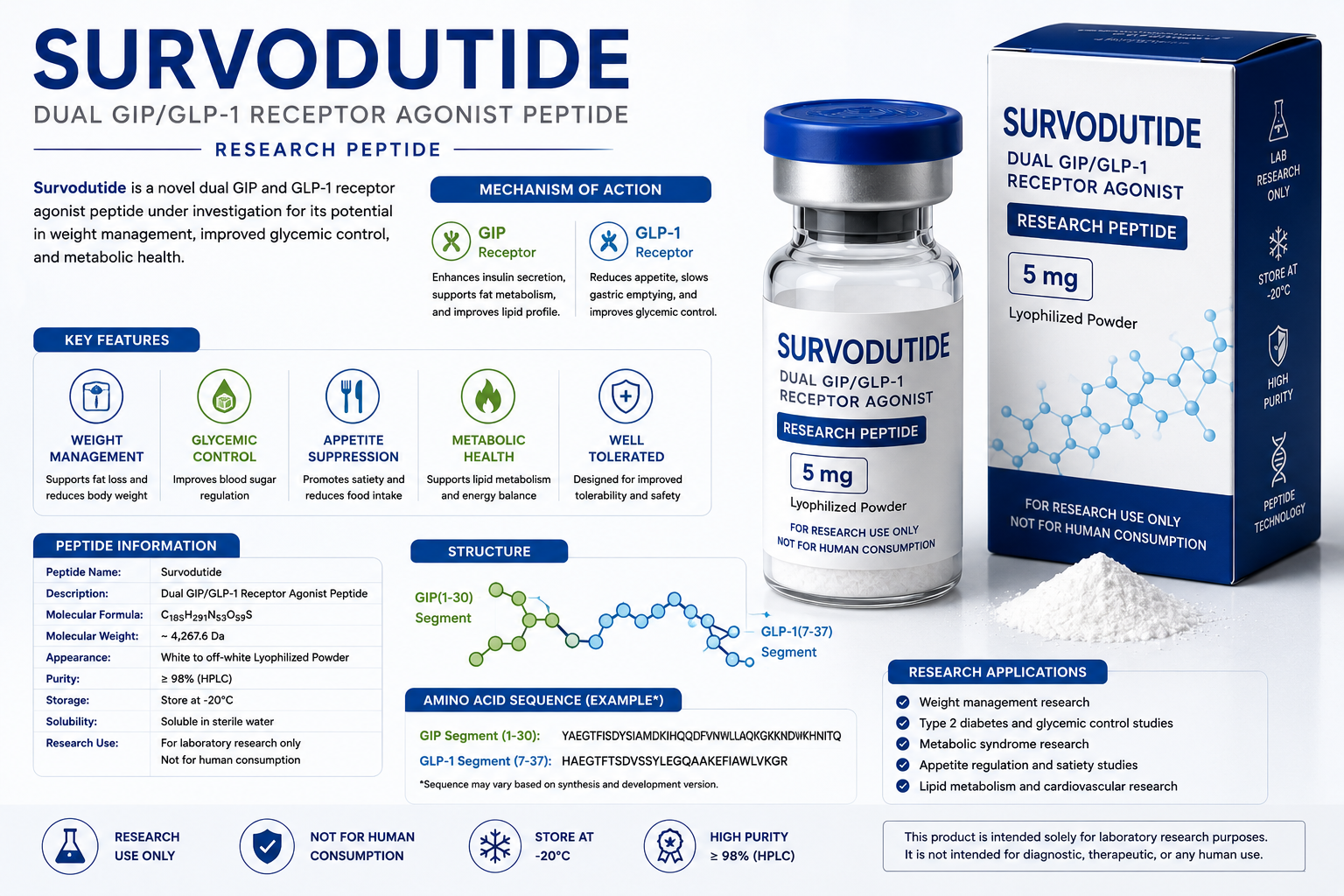
The landscape of metabolic research is shifting rapidly. For years, GLP-1 receptor agonists like semaglutide dominated the conversation, but a new era of “multi-agonists” has arrived. At the forefront of this evolution is the comparison of survodutide vs retatrutide. While both represent a significant leap forward from single-receptor therapies, they utilize different biological pathways to achieve weight loss and metabolic repair.
Survodutide (BI 456906) is a dual agonist targeting both the GLP-1 and glucagon receptors. Retatrutide, on the other hand, is a triple agonist that adds a third target: the GIP receptor. Understanding the nuances of these two compounds is essential for researchers and clinicians looking to understand the future of obesity and liver disease treatment. This guide provides an evidence-based breakdown of survodutide’s mechanism, clinical results, and how it stacks up against its closest rivals.
What is Survodutide?
Survodutide is a 29-amino-acid peptide co-developed by Boehringer Ingelheim and Zealand Pharma. It is currently being investigated for its potential to treat obesity and Metabolic Dysfunction-Associated Steatohepatitis (MASH), formerly known as NASH.
Unlike traditional GLP-1 drugs that primarily focus on appetite suppression, survodutide employs a “dual-action” strategy. By activating both the Glucagon-Like Peptide-1 (GLP-1) receptor and the Glucagon receptor (GCGR), it mimics the natural gut hormone oxyntomodulin. This dual approach is the primary reason why the survodutide vs retatrutide debate has gained so much traction; researchers are eager to see if dual or triple agonism provides the optimal balance of efficacy and safety.
How It Works: The Dual-Agonist Mechanism
The mechanism of survodutide is distinct from the single-target peptides of the past:
1.GLP-1 Receptor Agonism: Similar to semaglutide, this component slows gastric emptying and signals the brain to reduce hunger and increase satiety.
2.Glucagon Receptor Agonism: This is the “secret sauce” of survodutide. Glucagon activation increases energy expenditure (thermogenesis) and acts directly on the liver to promote fatty acid oxidation.
When comparing survodutide vs retatrutide, it is important to note that while both utilize glucagon, retatrutide’s addition of GIP (Glucose-dependent Insulinotropic Polypeptide) is designed to further enhance insulin secretion and potentially mitigate some of the gastrointestinal side effects associated with glucagon and GLP-1.
Survodutide vs Retatrutide: The Battle of Potency
The most frequent question in metabolic research today is how these two heavyweights compare. While head-to-head clinical trials are still pending, we can draw significant insights from their respective Phase 2 and Phase 3 data.
Efficacy in Weight Loss
In the survodutide vs retatrutide comparison, retatrutide currently holds the edge in pure weight loss percentage. Eli Lilly’s retatrutide Phase 2 data showed an astonishing weight loss of up to 24.2% at 48 weeks. In contrast, survodutide’s Phase 2 results showed a weight loss of 14.9% in the general analysis, with those completing the 4.8 mg dose reaching approximately 18.7%.
However, weight loss is only one part of the story. Survodutide has shown exceptional promise in liver health, which may give it a specialized niche in the survodutide vs retatrutide landscape for patients with concurrent fatty liver disease.
Comparison Table: Survodutide vs Retatrutide vs Mazdutide
| Feature | Survodutide | Retatrutide | Mazdutide |
| Mechanism | Dual (GLP-1 + Glucagon) | Triple (GLP-1 + GIP + Glucagon) | Dual (GLP-1 + Glucagon) |
| Developer | Boehringer Ingelheim / Zealand | Eli Lilly | Innovent / Eli Lilly |
| Peak Weight Loss | ~18.7% (46 weeks) | ~24.2% (48 weeks) | ~18.6% (48 weeks) |
| Primary Focus | Obesity & MASH | Obesity & Type 2 Diabetes | Obesity (China-focused) |
| Administration | Weekly Subcutaneous | Weekly Subcutaneous | Weekly Subcutaneous |
Mazdutide vs Survodutide: The Dual-Agonist Rivals
While the comparison focuses on dual vs. triple agonism, the competition between mazdutide and survodutide highlights two very similar dual agonists. Mazdutide, developed by Innovent in China, also targets GLP-1 and glucagon.
In the context of mazdutide vs survodutide, mazdutide has shown slightly higher weight loss percentages in Chinese populations, reaching 18.6% in Phase 3 trials. Some meta-analyses suggest that mazdutide may have a slightly better tolerability profile, though direct comparisons between these two dual agonists are often difficult to interpret due to differences in trial populations and regional dietary habits.
Research Applications: Weight Loss and MASH
Survodutide’s research applications extend far beyond simple weight management. Because it activates the glucagon receptor, it has a direct effect on liver metabolism that GIP-based triple agonists may not emphasize as heavily.
1. Obesity and Weight Management
The SYNCHRONIZE Phase 3 program is currently evaluating survodutide across a diverse range of participants. Topline results from SYNCHRONIZE-1 (April 2026) showed a 16.6% body weight reduction over 76 weeks. This confirms that while the survodutide vs retatrutide gap exists in speed, survodutide remains a powerful tool for long-term weight maintenance.
2. MASH (Metabolic-Associated Steatohepatitis)
Survodutide has received “Breakthrough Therapy” designation from the FDA for MASH. In Phase 2 trials, up to 83% of participants saw significant improvement in liver fat and inflammation without the worsening of fibrosis. This is a critical differentiator in the survodutide vs retatrutide debate, as survodutide may become the gold standard for liver-centric metabolic disorders.
Survodutide Dose and Dosing Chart
One of the most critical aspects of researching this peptide is understanding the escalation protocol. Because it activates two different receptor pathways, the body requires a significant period to adapt to the metabolic changes.
The standard amount administered starts very low to minimize gastrointestinal distress. Clinical trials typically utilize a 20-week titration schedule. Researchers often refer to a survodutide dosing chart to track these increments, which usually progress as follows:
Survodutide Dosing Chart (Clinical Trial Protocol)
| Week | Dose (mg) | Purpose |
| 1–4 | 0.3 mg | Initial Adaptation |
| 5–8 | 0.6 mg | Titration |
| 9–12 | 1.2 mg | Titration |
| 13–16 | 2.4 mg | Therapeutic Threshold |
| 17–20 | 3.6 mg | Advanced Titration |
| 21+ | 4.8 mg | Maximum Maintenance Dose |
Note: The therapeutic dose is administered once weekly via subcutaneous injection. In research settings, the survodutide dosing chart is strictly followed to ensure participant safety and data integrity.
Survodutide Side Effects and Safety
Like all peptides in the GLP-1 class, survodutide side effects are primarily gastrointestinal. However, the addition of the glucagon receptor can sometimes intensify these effects during the initial weeks of treatment.
Common adverse reactions include:
•Nausea: Reported by a significant percentage of trial participants, usually during dose increases.
•Vomiting and Diarrhea: Often transient but can lead to dehydration if not managed.
•Increased Heart Rate: A known effect of both GLP-1 and glucagon receptor activation.
•Injection Site Reactions: Redness or itching at the site of administration.
In the survodutide vs retatrutide comparison, both drugs share similar safety profiles, though retatrutide’s GIP component is theorized to help stabilize blood sugar more effectively, potentially reducing the “crashes” some feel on pure GLP-1/Glucagon dual agonists.
Survodutide FDA Approval Status (2026 Update)
As of mid-2026, official FDA approval for survodutide has not yet been granted for general use. The drug is currently in Phase 3 clinical trials, which is the final stage before a New Drug Application (NDA) can be submitted.
The timeline for this regulatory milestone is expected to follow the completion of the SYNCHRONIZE and LIVERAGE trials. Given its Breakthrough Therapy status for MASH, many experts anticipate that a green light for liver-related indications may arrive sooner than its approval for general obesity, potentially by late 2026 or early 2027.
Storage, Handling, and Reconstitution
For research purposes, survodutide is typically provided as a lyophilized (freeze-dried) powder. Proper handling is essential to maintain the peptide’s structural integrity.
•Reconstitution: The powder must be mixed with Bacteriostatic Water. It is important to avoid vigorous shaking; instead, gently swirl the vial until the powder is completely dissolved.
•Storage: Before reconstitution, vials should be stored in a freezer. After reconstitution, the peptide must be kept refrigerated at 2°C to 8°C (36°F to 46°F).
•Shelf Life: Reconstituted survodutide is generally stable for up to 28–30 days when kept under proper refrigeration.
Frequently Asked Questions (FAQs)
Is survodutide better than tirzepatide?
The survodutide vs retatrutide and tirzepatide comparisons are complex. Tirzepatide (Mounjaro/Zepbound) targets GLP-1 and GIP. Survodutide targets GLP-1 and Glucagon. Survodutide may offer superior benefits for liver fat reduction, while tirzepatide is currently the gold standard for blood sugar control and weight loss efficacy among approved drugs.
How long does it take to see results on survodutide?
Significant weight loss typically begins to manifest after the 12-week mark, once the therapeutic level of 2.4 mg or higher is reached.
Can survodutide be taken orally?
Currently, survodutide is only available as a subcutaneous injection. While oral GLP-1s are in development, there is no current oral version of survodutide in Phase 3 trials.
What is the main difference in survodutide vs retatrutide?
The main difference lies in the receptors they target. Survodutide is a dual agonist (GLP-1 + Glucagon), while retatrutide is a triple agonist (GLP-1 + GIP + Glucagon). This makes retatrutide potentially more potent for weight loss but also more complex in its pharmacological profile.
Conclusion
The comparison of survodutide vs retatrutide represents the cutting edge of metabolic science. While retatrutide may currently lead in terms of total weight loss percentages, survodutide’s dual-action mechanism—specifically its potent effect on liver health—makes it a formidable contender in the race to treat obesity and MASH.
As we await the final survodutide fda approval, the data from the SYNCHRONIZE trials continues to paint a promising picture. For researchers, understanding the survodutide dose escalation and monitoring for survodutide side effects are the keys to unlocking the potential of this next-generation peptide. Whether it is mazdutide vs survodutide or the broader survodutide vs retatrutide debate, one thing is clear: the future of weight loss is no longer just about suppressing appetite—it’s about optimizing the entire metabolic system.
Image Suggestions & Alt Text
1.Infographic: Dual vs Triple Agonism – Alt Text: A diagram comparing the receptor targets of survodutide vs retatrutide, showing GLP-1, Glucagon, and GIP pathways.
2.Graph: Phase 3 Weight Loss Results – Alt Text: A line graph showing body weight reduction over 76 weeks for survodutide vs placebo in the SYNCHRONIZE-1 trial.
3.Photo: Peptide Reconstitution Process – Alt Text: A researcher carefully reconstituting a peptide vial with bacteriostatic water for clinical study.
Authoritative External References
1.Boehringer Ingelheim: Survodutide Phase 2 Results for Obesity
2.New England Journal of Medicine: Retatrutide Phase 2 Trial Data
3.The Lancet: Survodutide Efficacy in MASH and Liver Fibrosis
4.ClinicalTrials.gov: SYNCHRONIZE-1 Study Details (NCT05791266)
5.FDA: Breakthrough Therapy Designations for Metabolic Drugs
The Evolution of Incretin Mimetics: From Single to Triple Agonism
To appreciate the significance of the survodutide vs retatrutide comparison, one must look at the history of metabolic pharmacology. The journey began with the discovery of Glucagon-Like Peptide-1 (GLP-1), a hormone produced in the gut that stimulates insulin secretion and suppresses appetite. The first generation of GLP-1 agonists, such as Exenatide and Liraglutide, proved that targeting this pathway could lead to modest weight loss and improved glycemic control.
However, the “ceiling” for weight loss with single-agonist therapy was eventually reached. This led researchers to explore multi-agonist molecules that could hit multiple metabolic targets simultaneously. Tirzepatide was the first breakthrough in this category, combining GLP-1 with Glucose-dependent Insulinotropic Polypeptide (GIP). Now, with the emergence of glucagon-targeting peptides, we are entering a third generation of therapy.
The Role of Glucagon in Metabolic Repair
In this new landscape, the inclusion of glucagon is a radical departure from earlier strategies. Traditionally, glucagon was viewed solely as a “counter-regulatory” hormone that raised blood sugar. However, modern research shows that when balanced with GLP-1, glucagon can:
•Stimulate Lipolysis: Breaking down stored fat in the liver and adipose tissue.
•Increase Thermogenesis: Elevating the body’s resting metabolic rate.
•Improve Lipid Profiles: Lowering LDL cholesterol and triglycerides through hepatic pathways.
This is why the survodutide vs retatrutide debate is so critical—both drugs leverage this “new” understanding of glucagon to achieve results that were previously only possible through bariatric surgery.
Deep Dive: The LIVERAGE and SYNCHRONIZE Programs
The development of survodutide is structured around two massive clinical programs: SYNCHRONIZE for obesity and LIVERAGE for MASH. These programs are designed to provide the robust evidence needed for survodutide fda approval.
SYNCHRONIZE: Redefining Weight Loss
The SYNCHRONIZE program consists of several sub-trials (SYNCHRONIZE-1, 2, and CVOT). While the comparison often focuses on the “top-line” weight loss percentage, SYNCHRONIZE is also looking at long-term cardiovascular outcomes. The goal is to prove that survodutide doesn’t just reduce weight but also lowers the risk of heart attacks and strokes in high-risk populations.
LIVERAGE: A Cure for MASH?
Perhaps the most exciting area of research is the LIVERAGE program. MASH is a leading cause of liver transplants worldwide, and currently, there are very few approved treatments. By targeting the glucagon receptor in the liver, survodutide has shown a unique ability to “melt” liver fat. In the survodutide vs retatrutide comparison, this liver-specific efficacy is where survodutide may truly shine, as it addresses the underlying metabolic dysfunction of the liver more directly than GIP-focused triple agonists.
Choosing the Right Research Pathway: Survodutide vs Retatrutide
When designing a metabolic study or considering future clinical applications, the choice between survodutide vs retatrutide often comes down to the primary metabolic goal:
1.For Maximum Weight Loss: Retatrutide is currently the frontrunner. Its triple-agonist profile appears to offer a higher “peak” efficacy for body mass reduction.
2.For Liver Health and MASH: Survodutide is the stronger candidate. Its Breakthrough Therapy designation and Phase 2 liver fat results are currently unmatched in the dual/triple agonist space.
3.For Tolerability: The jury is still out. While retatrutide uses GIP to potentially offset GI issues, survodutide’s slower titration protocol in Phase 3 has shown significant improvements in patient retention.
The Future of Multi-Agonists and Metabolic Health
The survodutide vs retatrutide era is just the beginning. Researchers are already looking at “quadruple agonists” and even more targeted peptide delivery systems. However, for the next 3–5 years, these two molecules will likely define the standard of care for metabolic disease.
The shift toward evidence-based, multi-receptor targeting represents a fundamental change in how we view obesity. It is no longer seen as a failure of willpower but as a complex hormonal imbalance that requires a sophisticated, multi-pronged pharmaceutical approach. Whether through the dual action of survodutide or the triple action of retatrutide, the goal remains the same: restoring metabolic health and preventing the long-term complications of chronic disease.