
Blog
Mazdutide vs Tirzepatide: Comparing Two Dual-Agonist Metabolic Therapies

Introduction
The metabolic drug landscape has moved fast over the past few years. Semaglutide and tirzepatide reshaped weight management and type 2 diabetes treatment, and now a new wave of dual- and triple-hormone agonists — mazdutide, retatrutide, survodutide — is generating intense research interest as the next potential step forward. ( Mazdutide vs Tirzepatide)
Among these, mazdutide vs tirzepatide is one of the most searched comparisons, largely because both drugs work on overlapping but distinct hormonal pathways. This article breaks down how mazdutide compares to tirzepatide, retatrutide, survodutide, and semaglutide, what the clinical trial data actually shows, current regulatory status across major markets, and the latest mazdutide news as of mid-2026.
What Is Mazdutide?
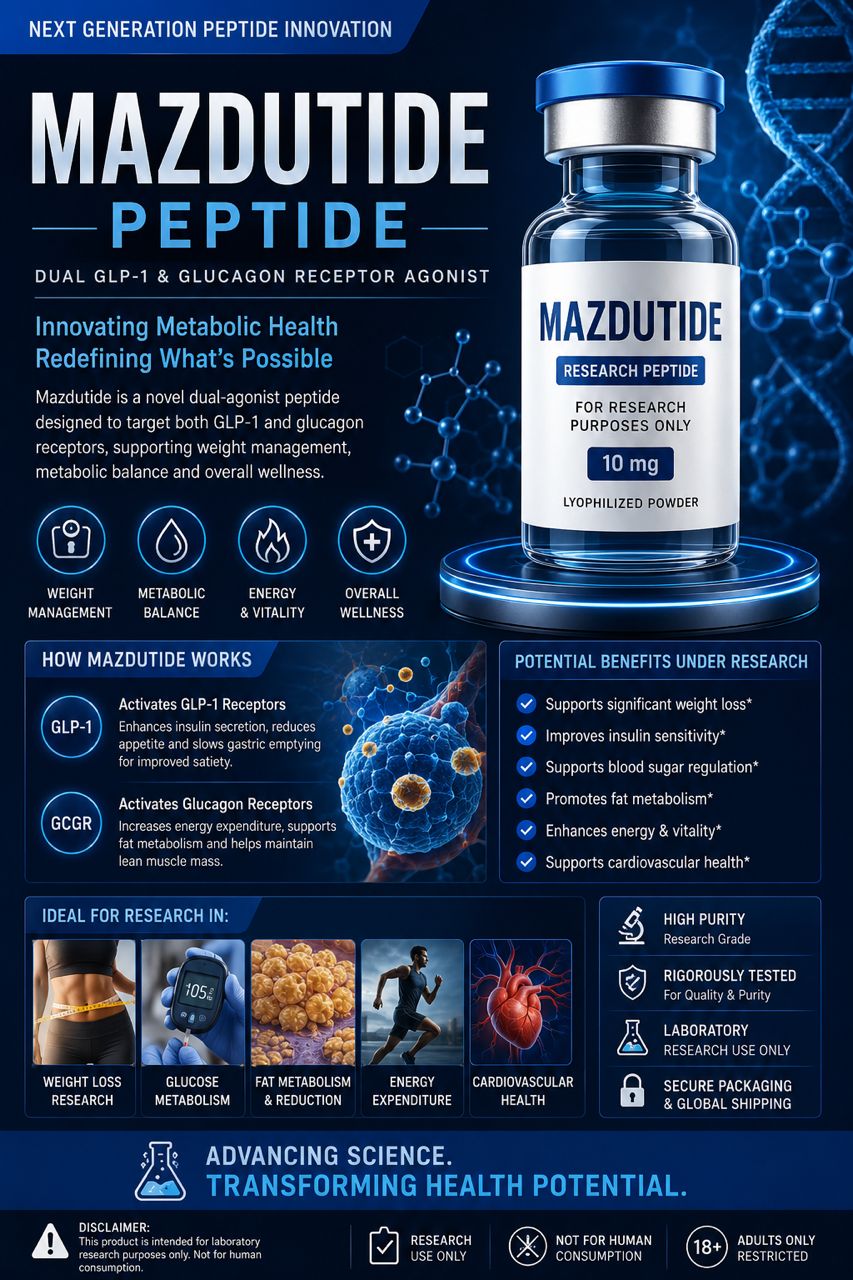
Mazdutide (also known by its development codes IBI362 or LY3305677) is a once-weekly injectable peptide that acts as a dual GLP-1 and glucagon receptor agonist. It was developed by Innovent Biologics in partnership with Eli Lilly, and it’s structurally based on oxyntomodulin, a naturally occurring gut hormone.
Mazdutide received regulatory approval in China in 2025 for type 2 diabetes, supported by Phase 3 trial data published in the New England Journal of Medicine. International development is ongoing, with head-to-head trials against semaglutide (the DREAMS-3 study) underway and expected to report in 2026. Mazdutide vs tirzepatide is one of the most searched comparisons, largely because both drugs work on overlapping but distinct hormonal pathways.
How Mazdutide Works: Mechanism of Action
Understanding the mazdutide vs tirzepatide debate starts with mechanism, since the two drugs share one target and differ on the second.
- GLP-1 receptor agonism (shared by both drugs): slows gastric emptying, reduces appetite, and improves insulin secretion in response to food.
- Tirzepatide’s second target — GIP receptor: glucose-dependent insulinotropic polypeptide enhances insulin secretion and may improve GLP-1 tolerability by moderating nausea.
- Mazdutide’s second target — glucagon receptor (GCGR): glucagon receptor agonism increases energy expenditure and promotes hepatic lipid mobilization — a metabolically different effect than GIP agonism.
These are not interchangeable mechanisms. GIP agonism and glucagon agonism affect different downstream pathways, which is part of why researchers are interested in comparing real-world outcomes between the two drug classes rather than assuming similar effects.
Mazdutide vs Tirzepatide: What the Trial Data Shows
Mazdutide vs tirzepatide is one of the most searched comparisons, largely because both drugs work on overlapping but distinct hormonal pathways. This is the core question driving search interest, and the honest answer is: there is no completed head-to-head trial between mazdutide and tirzepatide. All available comparisons come from separate trials in different populations, which limits how directly the results can be compared.
| Mazdutide | Tirzepatide | |
|---|---|---|
| Targets | GLP-1 + Glucagon (GCGR) | GLP-1 + GIP |
| Reported weight loss | Up to ~18.6% (60 weeks, per published trial data) | Up to ~20.9% (72 weeks, SURMOUNT trials) |
| Population studied | Primarily Chinese adults | Global, multi-ethnic populations |
| Approval status | China (T2D), 2025 | US, UK, EU, Australia (as Mounjaro/Zepbound) |
| Trial duration compared | 60 weeks | 72 weeks |
Because the studies differ in length, population, dosing, and design, the percentage figures above shouldn’t be read as a strict efficacy ranking. As one clinical comparison resource put it plainly: these come from different populations and study designs and cannot be directly compared.
What’s clearer is the tolerability side. A 2025 network meta-analysis comparing glucagon receptor agonists found that mazdutide had a relatively favorable side-effect profile relative to other glucagon-pathway drugs in its class, though direct, randomized comparisons against tirzepatide specifically are still pending.
Lilly Mazdutide vs Novo Semaglutide
It’s worth clarifying a common point of confusion: mazdutide was developed by Innovent Biologics, in partnership with Eli Lilly for ex-China markets — not by Novo Nordisk. Semaglutide (Ozempic/Wegovy), by contrast, is a Novo Nordisk product and a single GLP-1 receptor agonist, without the second glucagon or GIP target.
The head-to-head DREAMS-3 Phase 3 trial is currently comparing mazdutide directly against semaglutide in Chinese adults with type 2 diabetes and obesity, with results expected in 2026 — this will be the first real head-to-head dataset between the two, rather than the indirect, cross-trial comparisons available today.
Mazdutide vs Retatrutide
Retatrutide takes the dual-agonist concept a step further: it’s a triple agonist, hitting GLP-1, GIP, and glucagon receptors simultaneously. In Phase 2 and Phase 3 obesity trials, retatrutide has produced some of the largest weight-loss figures reported for any incretin-based therapy to date — in the range of 22–29% in published trial data, compared to mazdutide’s reported range in the high teens.
A 2025 network meta-analysis comparing glucagon receptor agonists (mazdutide, retatrutide, survodutide, and cotadutide) found that retatrutide produced the greatest average weight reduction and the most significant HbA1c improvement among the group, while mazdutide and survodutide showed more favorable tolerability profiles. In other words, the apparent efficacy advantage for triple agonism may come with a tradeoff in side-effect burden — an active area of ongoing research rather than a settled conclusion.
Retatrutide remains investigational globally, including in the US, with Phase 3 trials (the TRANSCEND and TRIUMPH programs) still underway.
Mazdutide vs Survodutide
Survodutide, developed by Boehringer Ingelheim, is mazdutide’s closest mechanistic cousin — also a dual GLP-1/glucagon receptor agonist, but developed independently for global markets through the Phase 3 SYNCHRONIZE trial program.
Key differences:
- Development focus: Mazdutide is primarily developed and already approved in China; survodutide’s Phase 3 program is enrolling internationally.
- Reported weight loss: Phase 2 data for survodutide showed weight reductions in the high teens at higher doses over roughly 46 weeks — broadly comparable in range to mazdutide’s reported results, though again, not from a direct comparative trial.
- Tolerability: The same 2025 network meta-analysis found survodutide had the most favorable overall tolerability score among the four glucagon-pathway agents studied, narrowly ahead of mazdutide.
As with the other comparisons here, no completed head-to-head trial exists between mazdutide and survodutide, so any ranking should be treated as provisional until direct comparative data is published.
Mazdutide Side Effects: What’s Been Reported
Like other incretin-based therapies (GLP-1, GIP, and glucagon receptor agonists as a class), the most commonly reported side effects of mazdutide in published trials have been gastrointestinal:
- Nausea
- Diarrhea
- Vomiting
- Decreased appetite
- Constipation
These effects are typically most pronounced during dose escalation and tend to diminish with continued use, consistent with patterns seen across the broader GLP-1/glucagon drug class. In the comparative network meta-analysis discussed above, mazdutide showed a relatively higher rate of vomiting compared to survodutide and cotadutide specifically, while showing better overall discontinuation rates than retatrutide and survodutide in that same analysis.
Because mazdutide hasn’t completed the same scale of long-term, ethnically diverse trials as tirzepatide or semaglutide, its full long-term safety profile — particularly outside Chinese populations — is still being established. This is one of the key reasons international regulators have not yet granted approval outside China.
Mazdutide Dosing: Why We’re Not Publishing a Chart
Mazdutide is dosed at 2.5 mg–5 mg weekly via subcutaneous injection in educational protocols. A 10 mg vial reconstituted with bacteriostatic water yields about 3.33 mg/mL. This information is for research and educational use only.
Storage: Lyophilized: freeze at −20 °C (−4 °F); after reconstitution, refrigerate at 2–8 °C (35.6–46.4 °F); avoid freeze–thaw cycles.[7]
Reconstitute: Add 3.0 mL bacteriostatic water → ~3.33 mg/mL concentration (standard protocol).
Typical weekly range: 2.5–5 mg once weekly with gradual titration.
Easy measuring: At 3.33 mg/mL, 1 unit = 0.01 mL ≈ 33.3 mcg on a U‑100 insulin syringe.
Mazdutide News: Where Things Stand in 2026
- China approval (2025): Mazdutide received regulatory approval for type 2 diabetes in China, becoming Innovent’s first approved metabolic dual agonist.
- DREAMS-3 trial: The first head-to-head Phase 3 trial comparing mazdutide directly to semaglutide in Chinese adults with T2D and obesity is underway, with completion expected in early 2026.
- International trials: Global Phase 3 studies are ongoing to support potential approval in markets including the US, UK, EU, and Australia, though no completed submission has been made to those regulators as of mid-2026.
- Comparative research: Multiple 2025–2026 network meta-analyses have begun directly comparing mazdutide against retatrutide, survodutide, and cotadutide on efficacy and tolerability, offering the field’s first indirect benchmarking across this drug class.
- Mazdutide vs tirzepatide is one of the most searched comparisons, largely because both drugs work on overlapping but distinct hormonal pathways
Frequently Asked Questions
Is mazdutide approved in the US, UK, or Europe? No. As of mid-2026, mazdutide is approved only in China, for type 2 diabetes. It remains investigational and is not legally available for prescription or human use in the US, UK, EU, or Australia.
Is mazdutide better than tirzepatide? There’s no completed head-to-head trial between the two drugs, so this can’t be answered definitively. Separate trials suggest tirzepatide has produced somewhat greater average weight loss, but the studies differ in population, duration, and design, so direct comparison isn’t reliable yet.
How does mazdutide compare to retatrutide? Retatrutide is a triple receptor agonist (GLP-1/GIP/glucagon) and has shown larger average weight-loss figures in trials than the dual-agonist mazdutide, but with a comparatively higher reported rate of adverse events in some analyses.
What company makes mazdutide? Mazdutide was developed by Innovent Biologics, with international development rights partnered to Eli Lilly. It is not a Novo Nordisk product.
Can I get a prescription for mazdutide outside China? No. There is currently no legal, regulated pathway to prescribe or obtain mazdutide for human use outside China. International trials are ongoing, and approval timelines for other markets have not been confirmed.
What are the most common mazdutide side effects? Gastrointestinal effects — nausea, diarrhea, vomiting, and reduced appetite — are the most frequently reported, consistent with other drugs in the GLP-1/glucagon receptor agonist class.
A Note on Researching Metabolic Therapies
The dual- and triple-agonist drug class — spanning tirzepatide, mazdutide, retatrutide, and survodutide — represents one of the most active areas in metabolic medicine research today. As more head-to-head trial data emerges through 2026 and beyond, the comparative picture between these drugs will get considerably clearer. For now, the most reliable approach is to follow peer-reviewed trial publications and regulatory announcements rather than indirect, cross-trial percentage comparisons.
If you’re researching metabolic and weight-management therapies, talk to a licensed healthcare provider about which approved options are appropriate for your situation — investigational compounds like mazdutide are not currently a legal or medically supervised option outside China. Check out this product at collagenpeptideseu.
This article is for informational and research purposes only and does not constitute medical advice. Mazdutide is not approved for use in the US, UK, EU, or Australia. Always consult a licensed healthcare provider before making decisions about medical treatment.