
Blog
HGH Fragment 176-191: Benefits, Side Effects, and What the Research Actually Shows.

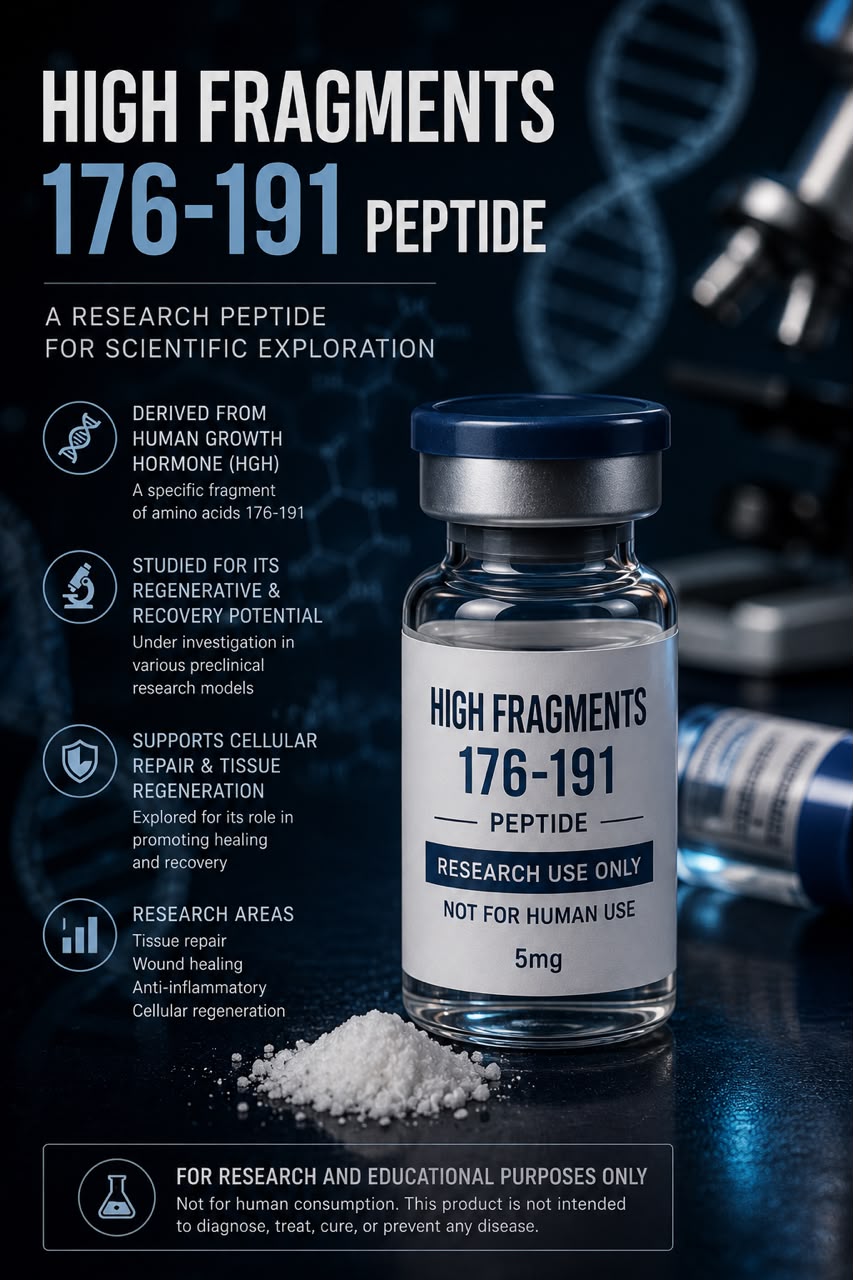
HGH Fragment 176-191 has become one of the most searched peptides in metabolic and body composition research — and one of the most misrepresented. Marketed aggressively in peptide communities as a “targeted fat burner” and “the lipolytic domain of growth hormone,” the reality of the research is more nuanced, and more honest, than most articles in this space will tell you.
This comprehensive guide covers what the HGH Fragment 176-191 peptide actually is, how it works at the molecular level, what the animal and human research genuinely shows (including where the evidence runs out), the documented side effects, what clinical dosing in supervised settings has looked like, how it compares to full HGH and its related compound AOD-9604, and the accurate regulatory and approval status across major markets. Whether you’re a researcher, a clinician, or someone who has encountered this peptide in a health or fitness context, this article gives you the full picture.
What Is HGH Fragment 176-191?
HGH Fragment 176-191 — also called GH Frag, hGH Fragment, or by its research alias AOD-9604 in modified form — is a synthetic peptide comprising amino acids 176 through 191 of the C-terminal end of the human growth hormone (hGH) polypeptide chain. Its amino acid sequence is YLRIVQCRSVEGSCGF, with a minor structural modification: tyrosine is substituted for phenylalanine at the N-terminal position to improve stability and bioavailability.
The full human growth hormone molecule performs a broad range of biological functions — stimulating growth, supporting protein synthesis, modulating insulin sensitivity, and triggering IGF-1 production. Researchers identified the C-terminal region (positions 176–191) as the segment most responsible for hGH’s lipolytic (fat-breaking) activity, and isolated it as a standalone peptide to study whether that specific metabolic function could be preserved without the other effects of full-length HGH.
The core hypothesis: a fragment targeting only the fat-metabolism pathway of growth hormone could promote lipolysis — the breakdown of stored fat for energy — without stimulating growth, raising IGF-1, or creating insulin resistance. That hypothesis has been partially supported in animal research, and partially contradicted in human trials, as we’ll cover in detail below.
HGH Fragment 176-191 Mechanism: How Does It Work?
Understanding the HGH Fragment 176-191 benefits claimed in research starts with its molecular mechanism, which differs meaningfully from full-length HGH.
Selective receptor binding. Rather than binding to the classical growth hormone receptor — which triggers the full hormonal cascade including IGF-1 production, protein synthesis, and growth signaling — HGH Fragment 176-191 binds to a distinct receptor subset on adipocyte (fat cell) surfaces linked to adenylate cyclase. This selectivity is what theoretically isolates its lipolytic effect from growth hormone’s anabolic and diabetogenic effects.
cAMP cascade activation. Upon binding, the fragment initiates a cAMP (cyclic adenosine monophosphate)-dependent enzymatic cascade that activates two key lipases: hormone-sensitive lipase (HSL) and adipose triglyceride lipase (ATGL). These enzymes accelerate triglyceride hydrolysis — breaking stored fat into fatty acids and glycerol — releasing those fatty acids into circulation for energy use.
Lipogenesis suppression. Simultaneously, the fragment appears to downregulate lipogenic enzymes, including acetyl-CoA carboxylase (ACC), reducing the rate at which new fat is synthesized and stored. This dual action — more fat breakdown, less fat storage — is the mechanistic basis for the lipolytic claims.
No IGF-1 induction. Unlike full-length HGH, HGH Fragment 176-191 does not appear to induce IGF-1 expression in research models, which means it does not trigger the growth-promoting, potentially proliferative effects associated with elevated IGF-1 — a meaningful distinction from traditional HGH therapy.
Beta-adrenergic signaling enhancement. Some research has suggested the fragment also enhances beta-adrenergic lipolytic signaling — the same pathway activated by exercise and stimulant-type compounds — independently of its receptor binding activity, though this mechanism is less well characterized than the cAMP pathway.
What the Research Actually Shows: Animal Studies
The most substantial body of research on HGH Fragment 176-191 comes from animal models, predominantly studies in obese mice. Here’s what that research found — and where it’s consistent:
Fat loss in obese animal models. A 2001 study by Heffernan et al. — one of the most cited in this area — found that growth hormone fragments increased fat metabolism and reduced weight gain in obese mice. Importantly, normal-weight mice did not experience the same fat-loss effect, suggesting the lipolytic activity may be particularly active in the context of existing metabolic dysfunction or elevated adiposity rather than functioning as a universal fat burner.
Lipolysis and reduced lipogenesis. Multiple rodent studies have confirmed the dual mechanism — increased lipolysis and reduced fat cell formation — in obese animal models, with body fat accumulation appearing reduced compared to placebo-treated animals at comparable timepoints.
Skeletal muscle thermogenesis. A 14-day study in overweight mice found HGH Fragment 176-191 appeared to boost skeletal muscle thermogenesis — increased heat production in muscle tissue associated with higher energy expenditure — alongside accelerated fat burning. This finding has attracted interest as a potential mechanism beyond direct lipolysis.
Cartilage research. Some animal model research has also explored HGH Fragment 176-191’s potential influence on cartilage growth and regeneration, though this is a much less developed research direction than the metabolic findings, with no clinical data to support it at this stage.
The critical caveat on animal research. Animal models — particularly obese mouse studies — do not reliably translate to human outcomes, particularly in metabolic research. The metabolic physiology of rodents differs significantly from humans, and the history of compounds that demonstrated strong fat-loss effects in obese mice but failed in human trials is long. This distinction matters for HGH Fragment 176-191 specifically, as we’ll cover next.
The Human Research Gap: What Clinical Trials Have Found
This is the part most articles in this space gloss over — and it’s the most important section for anyone making informed decisions about HGH Fragment 176-191.
No completed human clinical trials have ever been conducted on unmodified HGH Fragment 176-191. The fragment as commonly sold and researched in peptide communities has not been studied in a single published, peer-reviewed human clinical trial.
The closest human evidence comes from AOD-9604, a modified, stabilized version of Fragment 176-191 developed by Metabolic Pharmaceuticals specifically for pharmaceutical application. AOD-9604 underwent six human clinical trials between 2001 and 2007, studying its effects on body fat in overweight and obese adults. The findings were definitive: while AOD-9604 was found safe and well-tolerated in humans at the studied doses, it failed to produce statistically significant fat loss compared to placebo in controlled clinical settings.
This is not a minor footnote. It means the most rigorous human testing of the closest available analogue to HGH Fragment 176-191 — conducted over six separate trials — showed safety but no meaningful efficacy for fat loss in humans. Metabolic Pharmaceuticals subsequently sought FDA Generally Recognized as Safe (GRAS) status for AOD-9604 as a food ingredient rather than pharmaceutical approval for fat loss, given the lack of significant efficacy data. That application was granted for food ingredient purposes, but no pharmaceutical approval for obesity treatment was obtained.
The gap between the animal model results (positive for lipolysis) and the human clinical results (not significant for fat loss) is a real and important discontinuity that the current research literature acknowledges but peptide vendor content typically does not.
HGH Fragment 176-191 Before and After: Setting Realistic Expectations
HGH Fragment 176-191 before and after content is widely shared in fitness and biohacking communities, typically showing significant body composition changes attributed to the peptide. A few important points of context:
Confounding factors are almost always present. Before-and-after accounts in the peptide community almost universally involve simultaneous changes in diet, training, sleep, and often other compounds — making it impossible to isolate the effect of HGH Fragment 176-191 specifically. What reads as a peptide result is typically the result of a multi-variable lifestyle change.
Placebo effect in open-label use is well-documented. In clinical research, placebo-controlled trials routinely show that participants who believe they are receiving an active compound report meaningful subjective improvements. Uncontrolled anecdotes lack any mechanism to separate this effect from compound-specific activity.
The AOD-9604 human trials are the relevant benchmark. In double-blind, placebo-controlled conditions — where neither participants nor researchers knew who received the compound — the modified human analogue produced no statistically significant fat loss. That’s the most reliable benchmark available for what to expect from HGH Fragment 176-191 in a controlled human context.
Para que sirve HGH Fragment 176-191? (What is it for?) Based on the current evidence: animal model research into lipolytic mechanisms, and as a research compound for studying selective fat metabolism pathways. As a human fat loss intervention, the human evidence base does not yet support efficacy claims — the animal findings are promising mechanistically, but the human clinical translation has not been demonstrated.
HGH Fragment 176-191 Side Effects
Based on the AOD-9604 human trials and general peptide safety research, the HGH Fragment 176-191 side effects profile is considered relatively mild at studied doses. The most commonly noted in clinical and observational settings:
- Injection site reactions: Localized redness, mild swelling, or transient discomfort at the subcutaneous injection site — the most frequently reported side effect, consistent with other injectable peptides.
- Headache: Reported in some participants in the AOD-9604 human trials.
- Water retention: Mild, transient fluid retention has been noted in some accounts, though this was not a significant finding in the controlled trials.
- Hypoglycemia risk at elevated doses: Some research suggests that at very high doses, HGH Fragment 176-191 may affect glucose metabolism more significantly than at lower studied doses. This warrants caution, particularly in individuals with metabolic conditions.
- No androgenic or estrogenic activity: Unlike anabolic steroids or prohormones, HGH Fragment 176-191 does not appear to affect testosterone, estrogen, or other sex hormone pathways in available research.
- No significant IGF-1 elevation: Unlike full HGH therapy, the fragment does not appear to raise IGF-1, avoiding the proliferative concerns associated with chronically elevated IGF-1.
The AOD-9604 human trials consistently found the compound safe and well-tolerated — the safety profile is one of the few areas where animal model findings and human clinical data are in agreement. Long-term safety data in humans remains limited, given the absence of extended clinical trials.
HGH Fragment 176-191 vs Full HGH: Key Differences
Many people researching this peptide are doing so as a lower-risk alternative to full HGH therapy. The key comparative points:
| HGH Fragment 176-191 | Full-Length HGH | |
|---|---|---|
| Receptor target | Selective adipocyte subset | Full GH receptor (broad) |
| IGF-1 induction | None observed | Significant |
| Growth promotion | None | Yes |
| Insulin resistance risk | Not observed at studied doses | Yes, at therapeutic doses |
| Lipolytic effect (animal) | Demonstrated | Demonstrated (broader) |
| Human fat loss evidence | Not demonstrated (AOD-9604 trials) | Demonstrated but with significant side effects |
| Legal/prescription status | Unscheduled research compound in most markets | Prescription-only; controlled in many jurisdictions |
| Cost | Lower | Significantly higher |
The tradeoff is significant: full HGH has demonstrated human efficacy for fat loss (and many other effects) but comes with meaningful side effect risks and strict prescription controls. HGH Fragment 176-191 appears cleaner in its side-effect profile but has not demonstrated human fat-loss efficacy in controlled trials.
HGH Fragment 176-191 Dosage: What Clinical Research Used
HGH Fragment 176-191 dosage in the research context (including the AOD-9604 human trials) has varied. The AOD-9604 studies examined doses ranging from 1mg to 54mg daily in oral form for the modified compound — a different delivery route and formulation than the injectable unmodified fragment used in research communities.
For the injectable, unmodified Fragment 176-191 studied in animal models and used in functional medicine and research contexts, clinical providers typically work with protocols informed by the animal model research rather than a human clinical standard (since none exists for this compound). Because no approved human dosage exists — and because this compound has no regulatory approval for human use in the US, UK, EU, or Australia — providing a specific dosage chart or protocol here would be misleading at best. Any dosing should be determined by a licensed physician within a supervised clinical framework, based on individual assessment.
What the research does confirm is that the compound appears to exhibit a dose-response relationship in animal models, and that timing relative to food intake (specifically fasted state administration) appears relevant to activity, based on the metabolic context in which lipolysis is most active.
Regulatory and Approval Status
Is HGH Fragment 176-191 FDA approved? No. HGH Fragment 176-191 has no FDA approval, no MHRA approval, no EMA approval, and no TGA approval for any human use indication. It is not approved for weight loss, obesity treatment, or any other condition in any major regulated market.
AOD-9604, the modified version, received FDA GRAS (Generally Recognized as Safe) status as a food ingredient — not as a pharmaceutical drug for fat loss. This is a narrow designation about safety, not an efficacy approval.
In most jurisdictions, HGH Fragment 176-191 sits in a regulatory grey area: not a scheduled controlled substance (unlike full HGH, which is controlled in the US, UK, and elsewhere), but also not approved for human therapeutic use. It is legally classified as a research compound in most markets, meaning it can be sold for laboratory and research purposes but not marketed or sold for human consumption or therapeutic application.
Anyone considering this compound should do so only under physician supervision, within whatever legal framework applies in their specific jurisdiction.
HGH Fragment 176-191, Collagen, and Broader Body Composition Research
Body composition research — the intersection of fat metabolism, lean tissue preservation, and structural integrity — increasingly recognizes that no single compound or approach works in isolation. HGH Fragment 176-191’s research focus on lipolysis and fat metabolism sits alongside the growing evidence base on collagen peptides and their role in maintaining connective tissue integrity, skin elasticity, and joint health during periods of weight change or metabolic intervention.
When body fat decreases — whether through caloric restriction, exercise, pharmacological support, or peptide therapy — the structural protein systems that support skin and connective tissue are also affected. Research on collagen peptide supplementation in these contexts is an active area, with published data on how hydrolyzed collagen can support skin density, elasticity, and joint comfort alongside body composition changes. If you’re researching the broader landscape of metabolic health and structural tissue support, collagenpeptideseu.com provides a well-sourced look at the collagen peptide research relevant to this intersection.
Frequently Asked Questions
What is HGH Fragment 176-191? HGH Fragment 176-191 is a synthetic peptide comprising the C-terminal amino acids 176–191 of human growth hormone. It was developed to isolate the lipolytic (fat-burning) properties of growth hormone without its growth-promoting or insulin-antagonistic effects.
Does HGH Fragment 176-191 actually work for fat loss in humans? The animal model evidence is promising — multiple studies in obese rodents have shown reduced fat accumulation and increased lipolysis. However, the closest human trial data comes from AOD-9604 (a modified version), which failed to produce statistically significant fat loss compared to placebo in six controlled human studies. The human evidence base does not currently support efficacy claims.
What are the side effects of HGH Fragment 176-191? The most commonly reported include injection site reactions (redness, mild swelling), occasional headache, and mild transient water retention. No significant hormonal effects, IGF-1 elevation, or androgenic activity have been documented. The compound was found safe and well-tolerated in AOD-9604 human trials.
What is the difference between HGH Fragment 176-191 and AOD-9604? AOD-9604 is a stabilized, pharmaceutical-grade modification of Fragment 176-191 developed specifically for clinical trial use. The unmodified fragment and AOD-9604 are closely related but not identical. AOD-9604 underwent human clinical trials; unmodified Fragment 176-191 has not.
Is HGH Fragment 176-191 legal? In most jurisdictions (US, UK, EU, Australia), it is not a scheduled controlled substance but is also not approved for human therapeutic use. It exists as a research compound, legal to possess in many markets but not approved for human medical application.
How does HGH Fragment 176-191 compare to full HGH? Full HGH has demonstrated human fat-loss efficacy but comes with significant side effects including insulin resistance, IGF-1 elevation, and growth effects, plus strict prescription and controlled substance status. HGH Fragment 176-191 appears cleaner in side effects but has not demonstrated human fat-loss efficacy in controlled conditions.
Para que sirve el HGH Fragment 176-191? Se utiliza como compuesto de investigación para estudiar vías de metabolismo de grasa selectivas y lipolisis en modelos animales. No está aprobado para uso humano terapéutico en ningún mercado importante, y los ensayos clínicos humanos del compuesto relacionado AOD-9604 no demostraron pérdida de grasa significativa en comparación con el placebo.
Summary: What HGH Fragment 176-191 Is — and Isn’t
HGH Fragment 176-191 is a genuinely interesting research peptide with a well-characterized molecular mechanism and meaningful animal model evidence for selective lipolysis. Its theoretical advantage over full HGH — preserved fat-burning activity without growth, IGF-1, or insulin effects — is mechanistically sound and preclinically supported.
What it is not — at least based on current evidence — is a proven human fat burner. The most rigorous human data available, from six controlled AOD-9604 trials, found no statistically significant fat loss. That finding doesn’t necessarily mean the compound is ineffective in humans — it may mean the doses studied were insufficient, the formulation differed, or the study populations weren’t the most responsive. But it does mean the confident efficacy claims circulating in peptide communities are running well ahead of the evidence.
For researchers, clinicians, and individuals exploring this compound under medical supervision, that’s the accurate starting point: mechanistically promising, preclinically supported, human-unproven, and regulatory-unapproved outside research contexts.
This article is for informational and educational purposes only and does not constitute medical advice. HGH Fragment 176-191 is not approved for human therapeutic use in the US, UK, EU, or Australia. Always consult a licensed healthcare provider before making any decisions regarding peptide use or any other medical intervention.